SADC's Moment of Truth: Can Southern Africa Turn Unity Into Prosperity?
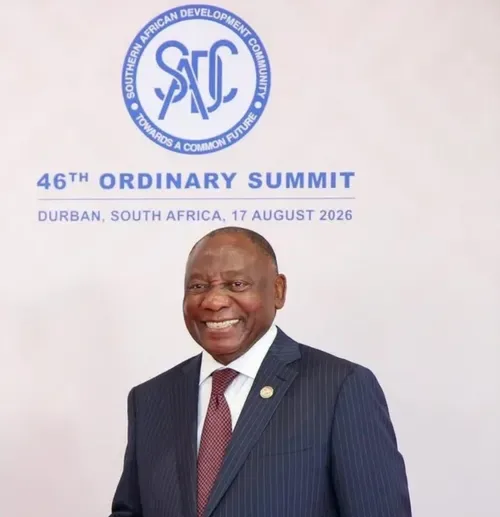
President Cyril Ramaphosa calls for SADC commitments to translate into construction projects, factories, power infrastructure, water systems, businesses and jobs that deliver tangible improvements to people’s daily lives.
SADC was born out of the political struggle against apartheid and colonial rule. Its founding states understood that the liberation of one country could not be separated from the freedom and stability of its neighbours. That history remains part of the organisation's identity.
But the challenges facing Southern Africa today are less about political liberation and increasingly about economic liberation.
A truck travelling from Zambia to South Africa can encounter multiple border crossings, administrative procedures and infrastructure bottlenecks before its goods reach their destination. Electricity shortages in one country can affect businesses across another. Drought does not stop at a national boundary. Neither do security threats, migration or economic shocks.
The region is therefore interconnected whether its systems are integrated or not.
One of the strongest messages emerging from the summit is the need to treat infrastructure as the backbone of regional integration.
SADC leaders have placed trade, infrastructure, energy and regional integration high on the agenda, with particular attention to improving border infrastructure and strengthening regional electricity cooperation.
Southern Africa has some of the continent's richest mineral deposits, major agricultural potential and significant energy resources. Yet these advantages are often undermined by weak transport links, unreliable electricity and expensive cross-border trade.
A road or railway connecting a mine to a port is not merely infrastructure. It is a potential supply chain. A more integrated electricity grid is not simply an engineering project. It can determine whether a factory operates consistently. A more efficient border can mean the difference between a profitable exporter and a business that loses money waiting for goods to move.
The summit's emphasis on critical minerals is particularly significant.
Southern Africa sits on resources that are increasingly important to the global energy transition, including lithium, cobalt, manganese, copper and platinum-group metals.
For decades, Africa's role in the global economy has largely been to export raw materials and import finished products. Critical minerals present another opportunity to break that pattern.
Instead of simply exporting minerals, SADC countries could develop regional value chains around processing, manufacturing and eventually technologies linked to batteries, renewable energy and electric mobility.
It makes little economic sense for every country to attempt to build every part of a supply chain independently. One country may have the mineral deposits, another the energy capacity, another the manufacturing capability and another the port infrastructure.
5News aggregated this summary from the outlet’s public feed. The full article, with all the context, is on iol.co.za — the content belongs to IOL.