A TRUE CLASSIC: Tomato bredie — the story, the history, and a tweak or two
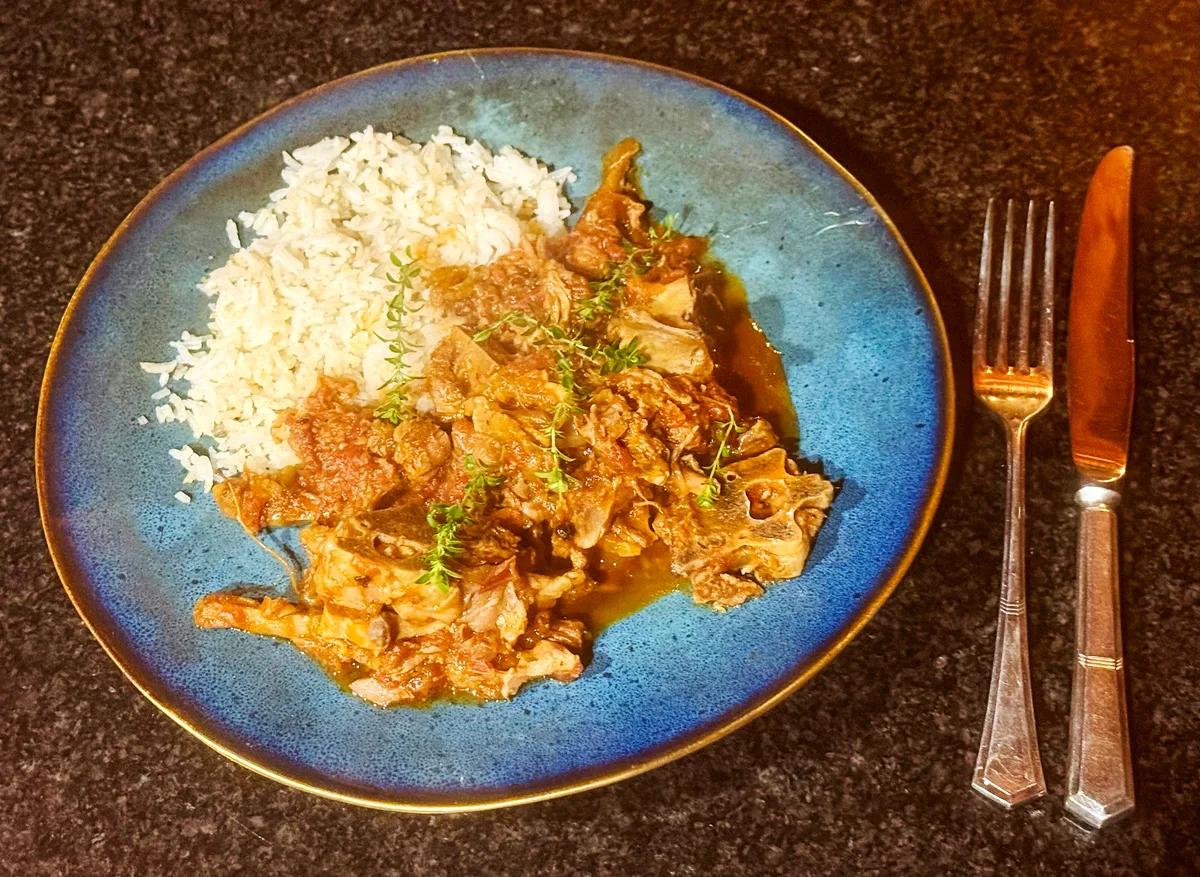
Tomato bredie is a worthy classic of South African cuisine and is not made nearly as often as it deserves to be. Given the full C Louis Leipoldt treatment, it is a fine dish that will charm the most discerning palate. Over time, my version – based loosely on Leipoldt’s – has evolved. Here’s the latest update.
In the old Cape kitchens, tomato bredie was one of those dishes that every self-respecting cook had their recipe for, and all would swear by their version. A tomato bredie, in its essence, is a stew of fatty mutton and tomatoes simmered for hours. But there’s more to it than that, especially if approached in the way of C Louis Leipoldt. If your first 21st century thought is, well, we’ll ditch the fat for starters, rather find another recipe. Fatty mutton is as much what a tomato bredie is all about as the tomatoes themselves.
So, you want mutton rib. Mutton because it’s richer in flavour than lamb, and rib because it has both bones and layers of fat. But first let’s go back a century and more...
Before writing this recipe in 2022, I delved into Renata Coetzee’s classic The South African Culinary Tradition , but found her tomato bredie recipe rather plain. In search of something more robust, I found C Louis Leipoldt’s recipe for it in Leipoldt’s Food & Wine , to discover that his version is cheese to Coetzee’s chalk. This with respect to Coetzee, whose book is a favourite of mine; but it simply sets out a basic formula for your ubiquitous tomato bredie. Hers has mutton (fatty), onion, chilli, 12 tomatoes, a little sugar, salt and pepper, and of course water. That’s it.
But veer over to Leipoldt’s Food & Wine and the story is very different. Instead of Coetzee’s eight ingredients (if you include the salt and pepper and the water, so just five without them), Leipoldt lists 18. Then, being Leipoldt, he adds a final “glass of wine” which frankly he seemed to put into everything. So: Leipoldt 19, Coetzee 8. Not that the quality of every dish rests on its number of individual ingredients, but in this case I have no doubt Leipoldt’s is in a higher league altogether; having made something approximating it and have it turn out truly delicious.
Now: in 2026, I’ve adapted it again. Instead of only mutton rib, last weekend I used lamb neck and lamb “ skenkels ”, or shanks sliced into smaller chunks, bone-in of course.
Because somebody was coming to dinner who avoids chillies, I decided to go a gentler route and added a teaspoon of piment ó n, the Spanish smoked paprika, to the tomato mix. I also used cans of chopped tomatoes instead of whole fresh ones, but don’t take this as gospel – use fresh by all means. I just wasn’t happy with the ripeness of the tomatoes available to me.
Another small adaptation was to use some passata, the strained tomatoes available in bottles or cartons. I did not add any wine, even for Leipoldt, this time around.
Put all the mutton and lamb into a heavy pot and add the sliced onions and leeks.
5News aggregated this summary from the outlet’s public feed. The full article, with all the context, is on www.dailymaverick.co.za — the content belongs to Daily Maverick.