Ramaphosa calls for ‘new era’ in South Africa-India economic ties at BRICS summit
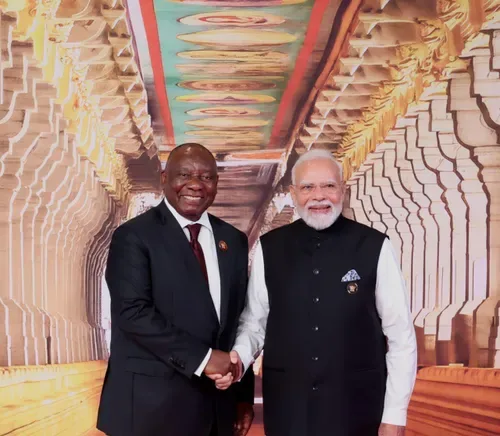
At a South African-Indian business roundtable in New Delhi on the sidelines of the 18th BRICS Leaders’ Summit, President Cyril Ramaphosa said policy dialogue now had to become commercially viable projects and durable private-sector partnerships.
PRESIDENT Cyril Ramaphosa, last Saturday, urged India and South Africa to open what he called a “new era” in economic relations, arguing that the two countries had a rare chance to deepen investment, trade, industrial development and sustainable growth at a moment when BRICS is rewriting the rules of the global economy.
Speaking at a South African-Indian business roundtable in New Delhi on the sidelines of the 18th BRICS Leaders’ Summit, Ramaphosa said policy dialogue now had to become commercially viable projects and durable private-sector partnerships. “We are ready for a new era in economic relations between our two countries,” he said. “This forum provides the private sector with an opportunity to transform policy dialogue into commercially viable projects and long-term partnerships.”
The meeting took place as BRICS leaders gathered in India’s capital. The grouping’s expanded membership brought together heads of state and senior officials from Asia, Africa, the Middle East and Latin America. The summit unfolded against a tense international backdrop, including a prolonged US-Iran conflict and the continuing war in Ukraine. China is due to assume the rotating BRICS presidency after India’s term.
Ramaphosa framed the moment as one of structural change rather than routine diplomacy, and as evidence that BRICS is no longer reacting to the rules of the global economy but writing them. Emerging markets, he said, are no longer on the margins of that story; they are driving a large share of global growth. In that setting, South Africa and India should treat complementary strengths as a joint asset rather than as parallel, disconnected stories.
That argument was not only delivered from the podium. I was in New Delhi as a guest of India’s Ministry of External Affairs for the BRICS week. Shopping across the city with other BRICS delegates, I watched ordinary purchases clear in rupees without the old detour through a third currency.
Ramaphosa later said publicly that he had tested the same path himself: he bought books in Delhi, paid in rupees, and the transaction resolved in rand. He told Prime Minister Narendra Modi there had been “no hiccups”.
I also visited India’s Stock Exchange and payment-cooperation work to see how that shift is being built rather than merely announced. The point of the visit was practical: rails, settlement, and the slow work of making a local-currency invoice as unremarkable as a card tap.
BRICS discussions on New Local-currency trade, cross-border payment experiments and talks between central banks have ensured that commerce between partners does not depend on a single switch elsewhere.
This is where the rewriting of the rules becomes concrete: not in declarations, but in whether an invoice can be settled without a third country’s permission.
5News aggregated this summary from the outlet’s public feed. The full article, with all the context, is on iol.co.za — the content belongs to IOL.