BUSINESS REFLECTION: Crossed Wires: The unbearable weirdness of humanoid robots
Now that robots are escaping the pages of novels and entering warehouses, hospitals and factories, one cannot help wondering whether the energy going into making them resemble people is just silly.
On 21 August a robot called Lightning broke Usain Bolt’s 100m record. You may have seen it on the news, it is everywhere. Me, I just got grumpy. Why? Stay with me.
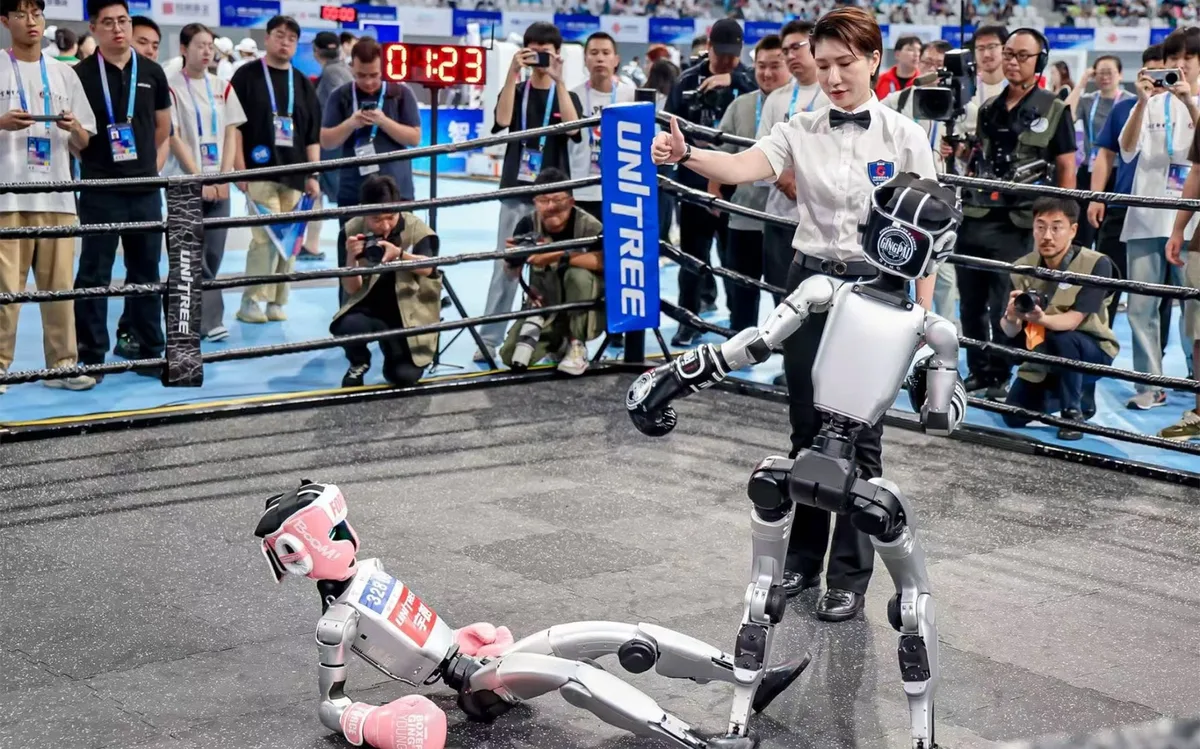
Over the past year or so there has been an uptick in videos showing humanoid robots doing all sorts of dazzling things. Running fast, jumping high, playing soccer, doing gymnastics. A recent one had robots competing in a kickboxing tournament, beating the actuators out of each other, with a worked-up human audience screaming in testosterone-fuelled glee. WTF? Is this what some of the smartest engineers in the world think is a productive use of their talents?
For centuries, robots belonged to the realm of fiction rather than engineering. Long before the first humanoid machines began rolling off production lines at Tesla, Boston Dynamics and more than 200 Chinese robotics start-ups, it seemed entirely reasonable to imagine that intelligent machines would also look rather like us. They were portrayed with two arms, two legs, a head and usually a face expressive enough to reassure or terrify the audience.
The humanoid robot became one of the great entertainment and literary devices of history. Hundreds of years of imagined automata. Isaac Asimov used them to explore morality through his Three Laws. Star Trek gave us Data, the machine forever trying to become more human. Blade Runner asked whether an artificial being could possess a soul. These stories worked because they were really about us. Giving intelligence a human shape allowed writers to examine consciousness, ethics and identity through a familiar mirror.
But science fiction is under no obligation to obey the mechanics of either engineering or economics. Or even common sense.
Now that robots are escaping the pages of novels and entering warehouses, hospitals and factories, one cannot help wondering whether the energy going into making them resemble people is just silly.
The human body is not a piece of pre-planned engineering, a clever invention designed to efficiently perform a task. We are more akin to an evolutionary compromise. We stand precariously on two legs because our ancestors needed to walk long distances while freeing their hands to carry infants, throw spears and gather food. We possess extraordinarily dexterous fingers because we manipulate an almost infinite variety of objects. Our shoulders rotate through astonishing angles because millions of years of evolution demanded climbing, reaching, throwing and lifting.
5News aggregated this summary from the outlet’s public feed. The full article, with all the context, is on www.dailymaverick.co.za — the content belongs to Daily Maverick.