State land could unlock faster renewable energy projects
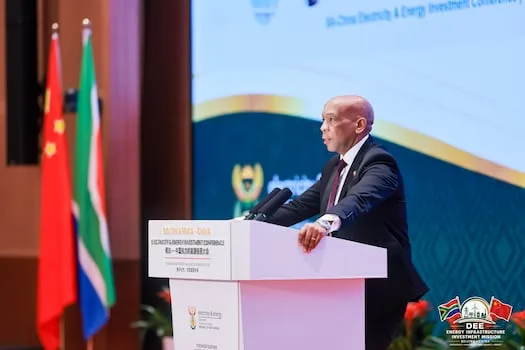
The department of electricity & energy (DEE) aims to tap into land owned by the government and state-owned enterprises to speed up the rollout of renewable energy projects in reforms that include government-led land procurement for battery storage projects.
The reforms are geared towards allowing investors to compete on price and technology rather than navigating complex land negotiations.
To this end, the department has issued a request for information (RFI) to gather information on government-owned land parcels that could be earmarked for competitive procurement of new generation capacity from a combination of energy sources, including renewable energy projects.
The department, led by Kgosientsho Ramokgopa , said it intends to use the information provided by government respondents to the RFI in response solely for the purpose of considering the potential feasibility of using government or state-owned land parcels in preparing procurement documentation for future Independent Power Producer Procurement Programmes (IPPPPs).
“The outcomes and information gathered pursuant to this RFI are intended to support the exploration of potential opportunities for alternative geographically targeted procurement approaches that could be used in the development of the IPPPPs and to gather information on site availability and readiness of any government/state-owned land parcels,” the RFI reads.
“This RFI could help determine the feasibility of and whether sufficient opportunities exist to augment the traditionally used purely developer/IPP-led site selection model in designing an appropriate procurement framework that is more location-specific — a designated development corridor procurement model for the IPPP programmes.
“The IPP office is conducting the studies pursuant to this RFI to explore the feasibility of more proactive procurer-led development models, especially where grid capacity in South Africa is currently constrained and project development timelines need to be shortened for accelerated delivery of the rollout of new generation capacity procured under the IPPP programmes.”
Some of the challenges and issues independent power producers have faced include severe grid-access bottlenecks where optimal land often sits far from functioning transmission lines.
A large chunk of South Africa’s land is in private hands, with only about 20% owned by the state.
5News aggregated this summary from the outlet’s public feed. The full article, with all the context, is on www.businesslive.co.za — the content belongs to Business Day.