SPOTS ON THE LINE: Roads versus roams — can culverts save Greater Kruger’s leopards on deadly R40 highway
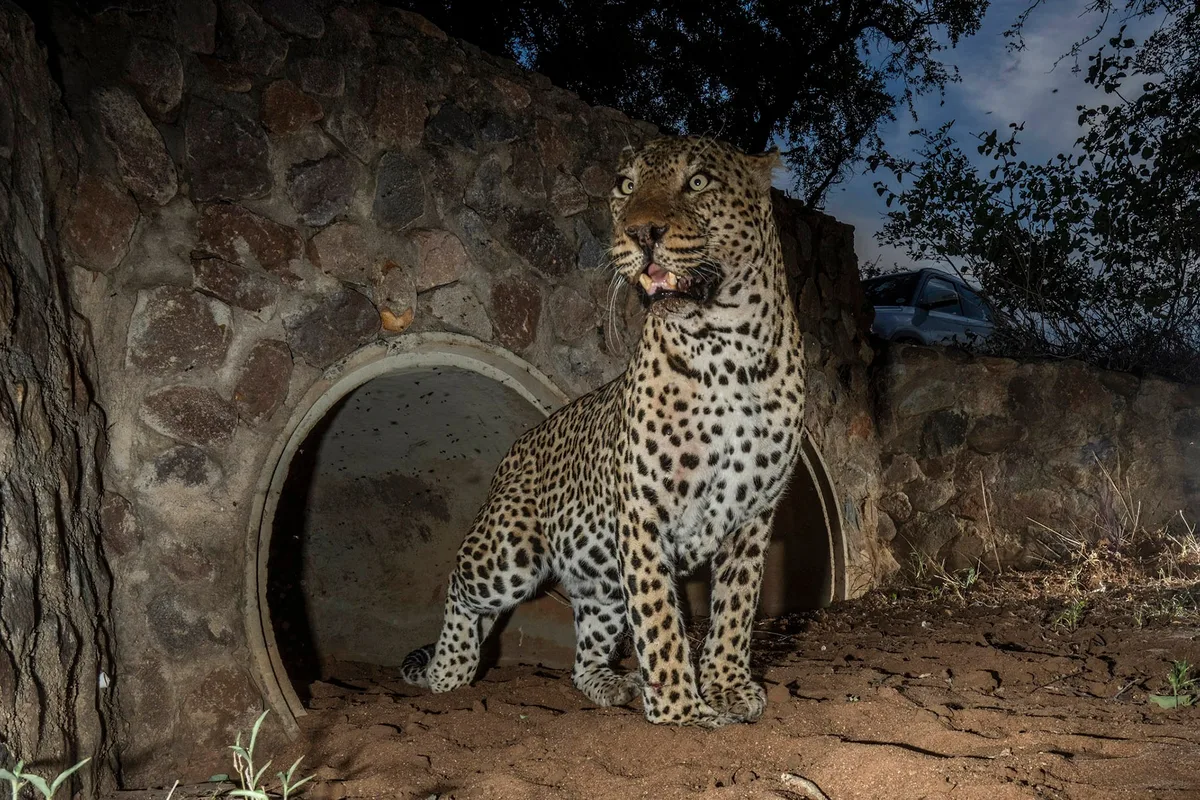
{JSON.stringify(article.attachments[0], null, 2)} --> The charismatic cats are slipping through tunnels snaking alongside the national park. Africa Geographic’s new documentary, Spots on the Line, tracks researchers using cameras and dogs to understand how wildlife moves through them – and if the answer to collisions on the road above has been beneath our wheels all along.
Somewhere along the R40 through Hoedspruit, South Africa’s safari capital in Limpopo province, a leopard reaches the road and has a choice.
It can cross the asphalt, where cars move through the increasingly urban landscape outside Kruger National Park. Or, it can disappear into a concrete opening beneath it.
The opening was never intended for a leopard, because it is there to move water underneath the road.
So are other animals, according to researchers studying wildlife movement along the busy artery tracing the park’s western boundary.
What road engineers call “culverts” have consequently become the subject of a conservation investigation to reduce wildlife road deaths. The Road Ecology Project , run by the Ingwe Research Programme , is trying to establish how animals negotiate a road laid across their movement corridors, why they use some of the tunnels beneath it and pass others by, and what might persuade more wildlife to go under, rather than over, it.
The answer, according to Africa Geographic’s new Spots on the Line documentary , could eventually involve engineering larger passages and directing animals towards them.
The documentary reveals why that is important – between May 2024 and August 2026, nine known leopards were killed on the region’s roads in collisions with cars – seven of these incidents were recorded on the R40. Several leopards were hit along a single 15km stretch.
Marine Servonnat, Ingwe executive director, would make the underground passages bigger if she could redesign the highway now.
“If we had the funding and authority, we would replace the current culverts so they are all at minimum 90cm in diameter,” she says. “It’s still not a simple fix: it’s a significant, site-specific engineering project and, on an artery like the R40, where the alternative route adds 30km on roads in poor condition, any solution has to work around keeping the road open.”
Before anyone starts rebuilding, however, Ingwe’s researchers and collaborators say they need to understand what is already happening beneath the traffic.
Christoffel de Lange, a research assistant with Transfrontier Africa NPC, a research partner in the project, says the study began with several basic knowledge gaps. Were animals already using these passages? If so, how often? And what made them more likely to use one?
The dry-season data delivered a clear answer to the first question. “There’s a number of species already using the culverts,” De Lange says, “from porcupines through to leopards, genets and warthogs.”
Some are using them remarkably often. “Porcupines use the culverts, if I remember correctly, more than 40 times per week.”
5News aggregated this summary from the outlet’s public feed. The full article, with all the context, is on www.dailymaverick.co.za — the content belongs to Daily Maverick.