GROUNDUP: Families living in Joburg stadium trapped among rubbish and rats
Years after being promised temporary shelter, hundreds of Johannesburg residents remain trapped in squalid conditions at Wembley Stadium with no clear path to permanent housing.
Hundreds of people who lost their homes in evictions or fires in Johannesburg’s inner city are living in tents and shacks in and around Wembley Stadium.
They were moved there years ago by the City of Johannesburg for temporary emergency accommodation (TEA). The first residents arrived in 2016. People are only supposed to stay in TEA for six months before moving to permanent housing. But the City has no plan to move the people at Wembley Stadium.
In fact, none of the TEA facilities across the City is in good standing, and residents have not been moved from any of them into independent living or another form of housing.
“When we got here there was electricity, and the toilets and water were working. There were even security guards here. Now we have none of those things,” said Ethel Musosoza, who was moved to the stadium following her eviction from Chung Hua Mansions on Jeppe Street in 2017.
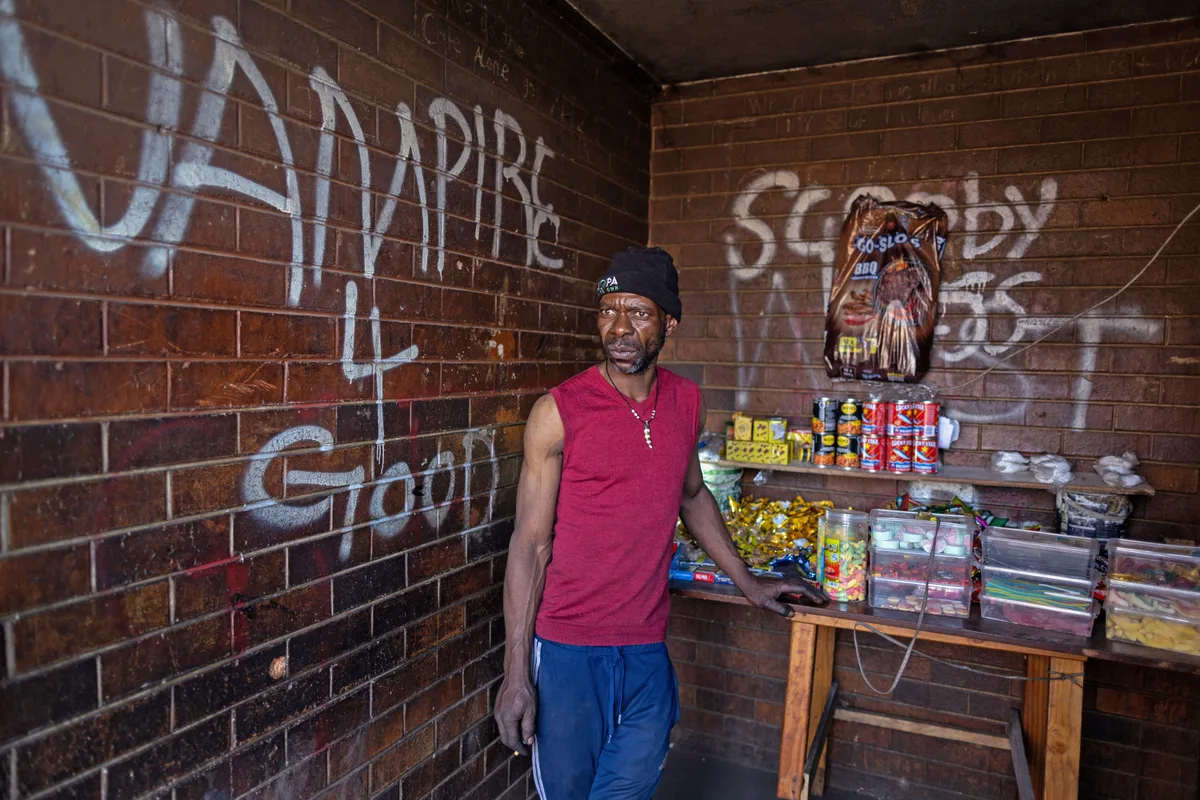
At least 350 people live on the property. Rubbish is piling up outside the building. Rats run through the site. The walls are covered in graffiti. Residents describe drug use and violence as part of daily life.
“It is very tough here for us… it’s dark and dirty and unsafe. It is even worse when you are a woman,” Musosoza said in the dimly lit room that she shares with her two children, her mother-in-law, and her aunt. “It feels like the government has forgotten about us.”
Other residents of the stadium were evicted from Fattis Mansions, another inner-city building, in July 2017. The Gauteng Division of the High Court in Johannesburg had ordered the City to assess those at risk of homelessness and provide suitable temporary emergency accommodation, including appropriate toilet facilities and security.
Some of them were initially housed in tents, with the City later saying it had to procure additional tents because it did not have enough available.
Another devastating fire at the Cape York building in 2017 led to more people being moved to the stadium. By July 2018, the City acknowledged that conditions in the tents were unsustainable and announced 70 prefabricated units at Wembley, with ablution facilities, running water and electricity.
There are container homes, but residents say these are reserved for South Africans – many of the people who were displaced from inner-city buildings are immigrants. The container homes are in a better condition than the main building, tents, and shacks where most of the residents live.
A man from Tanzania who lost his passport and most of his possessions in an inner-city fire in 2018, sells food and other snacks in the dark corridors of the building to survive. He did not want to give his name.
“I can’t go anywhere else because I don’t have enough money. I can’t get a job because I don’t have a passport any more. The government people said they will help us get new passports after the fire, but we are still waiting,” the man said.
“We are here because we have no other options.
5News aggregated this summary from the outlet’s public feed. The full article, with all the context, is on www.dailymaverick.co.za — the content belongs to Daily Maverick.