Eighty fighting years - the stand that laid the groundwork for ongoing struggle
The 1946 Passive Resistance Campaign marked a significant turning point in the struggle against apartheid. On the 80th anniversary, Selvan Naidoo and Kiru Naidoo revisit the courageous stand taken by ordinary South Africans against injustice. These brave individuals not only altered the course of history but also laid the groundwork for ongoing struggle and resilience in the face of adversity.
“We Shall Resist!” was the battle cry of the 1946 passive resistance campaign spearheaded by the Natal and Transvaal Indian Congresses. At issue was the racist law segregating residential areas. Durban defined the battleground.
The resistance shifted the strategic direction of the struggle for South African freedom in two significant ways.
One was that non-racialism as collective action entered the political lexicon by different races entering the struggle, even if symbolically.
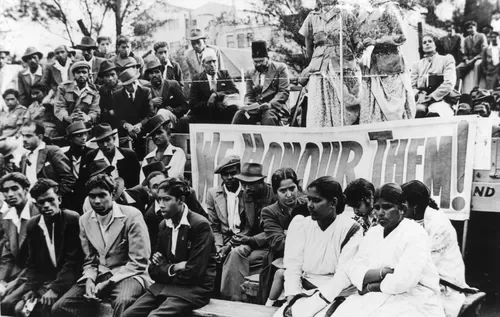
Passive resister Gadija Christopher and Dr K Goonam are seen at the passive resistance campaign of 1946.
The second was that racism in South Africa was placed firmly on the agenda of the newly-formed United Nations Organisation through the joint action of the African National Congress and the South African Indian Congress.
The dignity of housing was the spark. Populations were growing, yet the city council paid scant attention to the housing and developmental needs of its black peoples.
In the early 1940s, more prosperous members of the Indian community started buying properties in historically European neighbourhoods. This “Indian penetration” was met with demands for segregatory legislation.
First came the “Pegging Act” of 1943 that banned property transactions between Indians and whites. The 1946 Asiatic Land Tenure and Indian Representation Act followed. Laws targeting Indians were eventually to find countrywide application as the Group Areas Act of 1950, which became a cornerstone of apartheid.
Monty Naicker and fellow passive resisters set up a tent at Umbilo, Durban.
Between 1946 and 1948, a total of 10,267 resistors defied the law by occupying land forbidden to them.
Dr Jairam Reddy, chairperson of the Sastri College Alumni Society (SCAS), poignantly summed up their sacrifice: “(They) gave up their freedom so that we could be free.”
The resisters chose to be jailed, most frequently sentenced to hard labour. Their actions were revolutionary and passive only in so far as they did not resist arrest. SCAS was an instrumental partner in the construction of the Resistance Park Monument at the intersection of Gale Street and Umbilo Road and continues to lead commemorations on the anniversary of the campaign.
The campaign commenced with a historic mass meeting at Red Square on March 31, 1946, called by the radical leadership of the NIC that included, among others, doctors Monty Naicker and K Goonam, MD Naidoo, Fatima and Dawood Seedat, and Kay Moonsamy.
5News aggregated this summary from the outlet’s public feed. The full article, with all the context, is on iol.co.za — the content belongs to IOL.