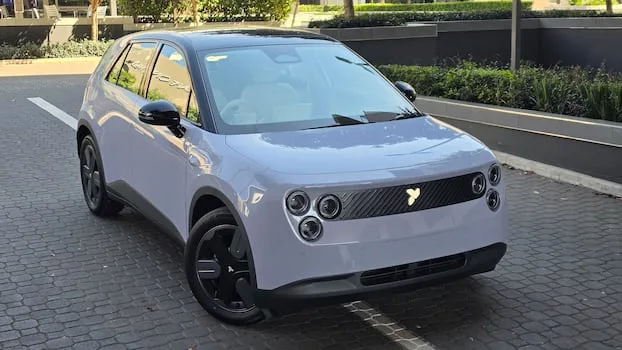
FIRST DRIVE | Nio Firefly makes good case for zero-emissions B-segment hatches
During the past five years, SA consumers have been exposed to entirely new automotive nameplates.
Titles that, a decade ago, were unheard of but are now climbing up sales charts to rival leading legacy players.
There is another one on the horizon. But if you are the kind of reader partial to keeping tabs on the overseas market, then the name Nio might not be all that foreign.
It is a Chinese brand specialising in electric vehicles, and its products are set to be released locally before the year ends. Kicking the business off is the new Firefly compact, which has the honour of being the 2026 World Urban Car category winner in the prestigious World Car Awards programme.
This reporter has the privilege of being one of the three SA jurors on the competition panel, which dates back to 2004.
Lebano Group will be responsible for distributing the Nio portfolio locally. Its core business is in mining, but this expansion into automotive is part of a longer-term strategy.
Lebano Group offered us an exclusive preview of the vehicle, and I spent five days with it.
The B-segment hatch is similar in dimensions to a Volkswagen Polo, with a useful five-door configuration.
The importer said the Firefly is not aimed at the budget end of the electric car market but is intended to compete with the GWM Ora 5 BEV and Mini Cooper Hatch SE.
In terms of dimensions, it is significantly larger than the BYD Dolphin Surf and the Geely E2, both A-segment runabouts.
And from behind the wheel, the Firefly certainly feels like a grown-up product, in line with what the GWM and Mini alternatives offer. It is 4,003mm long, 2,013mm wide and 1,557mm tall.
But before we get to the good, allow me to address the criticisms. The first negative point is that it uses an NFC card rather than a conventional key fob. We encountered this in the Leapmotor C10 and iCaur V23 and found it finicky and risky to be stranded if the card snaps.
As Volvo debuted with the EX30, the Nio Firefly has its side mirror adjustment controls in the interface. By now, many other Chinese brands have adopted this approach, so it was less jarring.
What we dislike is that even the ventilation direction controls are placed within the infotainment menus. This was a criticism even in the Porsche Taycan, and it applies here, because one can never really get the airflow direction just right.
5News aggregated this summary from the outlet’s public feed. The full article, with all the context, is on www.sowetanlive.co.za — the content belongs to Sowetan.