South Africa's Car Industry Is Winning and Losing at the Same Time
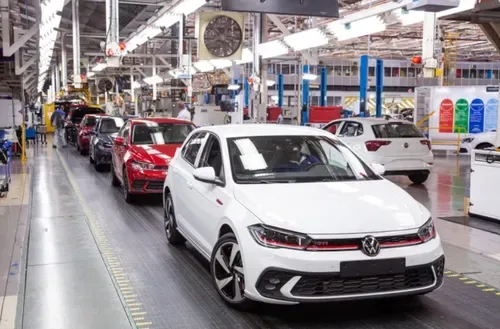
The Polo is South Africa's most prolifically produced vehicle at the moment.
The numbers on the showroom floor tell an uncomfortable story. New vehicle sales climbed 15.7% to 597,338 units in 2025, and the first half of 2026 kept accelerating, up 12.9% year-on-year to more than 315,000 units, with June posting its best result in 19 years. Ordinarily, that would be unambiguous good news. Instead, as component manufacturer Metair has warned, most of that growth is being captured by imported metal rather than local production. Suzuki, importing every unit from India, is now South Africa's second best-selling brand. Chery alone moved over 6,000 units in just the first four months of 2026, with GWM, BYD, MG, Geely and GAC all chasing the same momentum. The Industrial Development Corporation has calculated that Chinese imports helped drive a R140 billion trade deficit with China in the first nine months of 2025 alone, while India, chiefly through Suzuki and Mahindra, is an even larger source of the imbalance. Imports now account for roughly two-thirds of new car sales in South Africa, an extraordinary reversal for a country that still manufactures vehicles for BMW, Mercedes-Benz, Volkswagen, Toyota, Ford and Isuzu.
Nissan's Rosslyn plant is the clearest casualty so far. Financial difficulties forced Nissan to sell the factory to Chery earlier this year; it is now being retooled to build Chery Group vehicles from 2027, a symbolic handover of South African production capacity from a legacy Japanese brand to a rising Chinese one.
South Africa's predicament has a useful historical parallel, and it comes with two very different endings. Thailand, dubbed the "Detroit of Asia," faced the same import pressure decades ago and responded with sustained local-content rules, tax incentives tied to domestic production, and export-oriented industrial policy, it now assembles roughly two million vehicles annually and anchors Southeast Asia's auto supply chain. Australia took the opposite path. Unable to compete with cheaper imports and unwilling to keep subsidising local plants indefinitely, Canberra let protection lapse; Ford, Holden and Toyota all shut their Australian factories between 2016 and 2017, ending a century of local car manufacturing entirely. South Africa's Automotive Production Development Programme (APDP2) is, in effect, a bet on the Thai model over the Australian one, naamsa argues that every rand of APDP support generates nearly R4 in domestic manufacturing value and almost R8 in export earnings, having underpinned R137 billion in local value-addition in 2025. Critics, including some manufacturers themselves, say government has been slow to review the programme and is failing to keep pace with how aggressively Beijing and New Delhi are backing their own exporters.
It would be easy to read all this as inevitable managed decline, but the underlying industrial base remains formidable.
5News aggregated this summary from the outlet’s public feed. The full article, with all the context, is on iol.co.za — the content belongs to IOL.