BHEKISISA: A rural mother’s 30-year journey of caring for a son with cerebral palsy
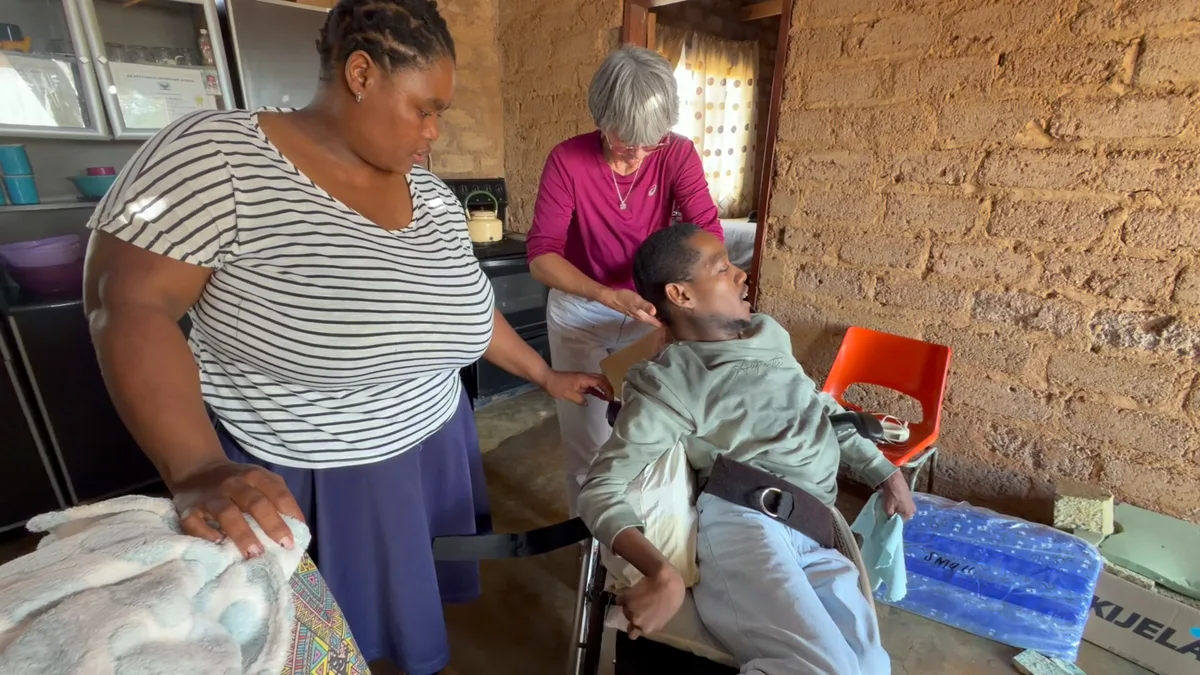
{JSON.stringify(article.attachments[0], null, 2)} --> When Keneilwe Dikoma took her six-month-old son Lorato for a routine check-up in rural North West, she learned that his missed milestones were signs of cerebral palsy – a diagnosis that would reshape both their lives. Thirty years on, she cares for him around the clock while passing on what she learned to other families and campaigning for better disability services in her community.
Cerebral palsy often announces itself in the space where a milestone should be.
For Keneilwe Dikoma, it was when she took her baby for his six-month check-up at a clinic near their home in Lotlhakane, a village of scattered homesteads and open veld in North West. By then, Lorato should have had the physical skills healthcare workers look for to make sure babies are on track – rolling over, pushing up with straight arms and sitting.
Dikoma was a teenager at the time, just 16, and it was her first child. He was a peaceful baby and smiled a lot from early on. She was smitten.
“I had a baby and I was happy,” she told Bhekisisa’s TV programme, Health Beat , about those early days, the time before the check-up, that September day in 1995 when her life would change in ways she could have never anticipated. That was the day the clinic sister told her something was wrong, that Lorato should have been sitting up by now, and sent her to the closest hospital.
She wouldn’t know it yet, but Dikoma would never go back to high school as she planned. Her life would be consumed by Lorato, who would be diagnosed with a condition she didn’t even know existed.
All she knew then was that she was scared. She started asking herself: Why me?
At Gelukspan District Hospital, Lorato was diagnosed with cerebral palsy (CP) , a group of permanent conditions affecting movement, posture and muscle control that are caused by damage to a child’s brain, or by that brain not developing normally. It can happen before or during birth, or at any point up to the age of two. Although the brain injury itself doesn’t get worse over time, the way it affects a child can change as they grow.
Globally, it is one of the most common causes of physical disabilities that start in childhood. Locally, CP is the most common condition for which provincial health departments are sued for medical negligence – with the highest payouts per case.
CP affects people differently. Lorato, now 31, has spastic quadriplegic CP , which affects all four limbs.
He uses a wheelchair and is wholly dependent on others to wash him, feed him and dress him. A tightness constantly grips his body, pulling it into a twist that has caused severe scoliosis , a curve in his spine. His body often jerks in movements which are difficult for him to control.
It’s not clear how much he understands – people with CP can also have intellectual disabilities – though those close to him say Lorato knows far more than he is able to express. His ability to communicate is limited; he uses sounds and eye movements to let people know what he needs, and can say a few words, but it is a sort of secret language unintelligible to most people.
But everyone in the village knows Lorato.
5News aggregated this summary from the outlet’s public feed. The full article, with all the context, is on www.dailymaverick.co.za — the content belongs to Daily Maverick.