At the centre of the Ebola epidemic in Congo – crisis and hope
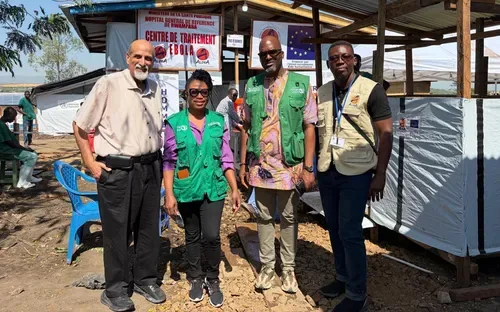
Salim S Abdool Karim with doctors Yap Boum, Kyeng Mercy and Papys Lame Musey at the Rwampara Hospital's Ebola Treatment Centre, near the city of Bunia.
IN MAY, the World Health Organization (WHO) and the Africa Centres for Disease Control and Prevention (Africa CDC) declared Ebola a public health emergency based on rising numbers of cases in the Democratic Republic of the Congo (DRC) and Uganda. Three weeks later, I went to Kinshasa, and thereafter to ground zero of the epidemic – Bunia, the capital of Ituri province in the DRC – to assist the Africa CDC in the Ebola response.
The "Red Zone" at the Evangelical Hospital in Kinshasa refers to the Ebola wards at the facility.
As of earlier this month, there were over 5 000 Ebola cases reported in the DRC. Of these patients, more than 2 500 have died. It is deeply concerning that almost half of all the patients with Ebola died. In fact, many were only diagnosed with Ebola after they died in the community. This Bundibugyo virus is spreading faster than any other Ebola virus epidemic in history. To see its devastation firsthand in the DRC was both shocking and moving.
In Kinshasa, my first stop was to visit the renowned Professor Jean-Jacques Muyembe at the Institut National pour la Recherche Biomedicale (INRB). The INRB is the national biomedical research laboratory for the Ministry of Health in the DRC.
Professor Muyembe described the first patients with Ebola, and Professor Peter Piot discovered the Ebola virus in 1976 – these two scientists, who are friends of mine, are credited with the discovery of Ebola. It was Professor Muyembe’s laboratory that first discovered in May that the virus in patients dying with fever and bleeding in Bunia was the Bundibugyo virus. He has an impressive setup, including a sophisticated, high-safety-level laboratory for Ebola built by the Japanese government. His laboratory was well set up to perform thousands of tests for the Bundibugyo virus each day.
I then flew to Bunia, which turned out to be a big challenge. The airport in Bunia is closed to routine commercial flights to avoid Ebola patients travelling by air to other parts of the world. So, I took a United Nations humanitarian flight at a makeshift terminal next to Kinshasa’s main airport terminal to catch the UN’s Humanitarian Air Services flight to Bunia. Ironically, the flight number was Ebola.1.
With Professor Jean-Jacques Muyembe, head of the Institut National pour la Recherche Biomedicale (INRB) in Kinshasa.
As I drove through the streets of Bunia for the first time, it reminded me of KwaZulu-Natal’s town of Ladysmith – a city that is quaint but struggling to keep up with its infrastructure development. Potholes are aplenty, drainage is compromised in places, and several streetlights are not working. The beauty of Bunia hides the reality that just outside of Bunia, there are thousands of displaced people living in tent camps – people displaced by war in Ituri province. This is a city in the middle of a long-standing conflict, which has internally displaced hundreds of thousands of Congolese.
In Bunia, I visited two Ebola Treatment Centres.
5News aggregated this summary from the outlet’s public feed. The full article, with all the context, is on iol.co.za — the content belongs to IOL.