Cyberbullying among South African teenagers: A study on its impact on mental health and academic performance
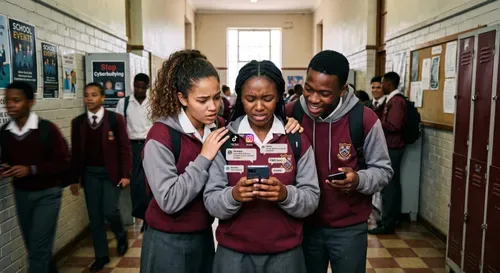
South African study reveals how online abuse derails high school pupils’ academic performance and mental health.
Nearly two-thirds of South African teenagers in top-tier schools are caught up in cyberbullying, a devastating culture of online harassment that directly undermines their mental health, classroom focus, and academic achievement.
According to groundbreaking research published in the South African Journal of Information Management by Professor Daniel le Roux of Stellenbosch University and Camryn Twaddle of Artefact South Africa, 63.9 per cent of pupils surveyed across five fee-paying Quintile 5 high schools reported involvement in digital abuse.
Far from being a passive issue, 37.3% of pupils acted as both victims and perpetrators, while 19.9% were strictly victims and 6.7% bullied others exclusively. Girls and boys reported virtually identical rates of involvement, at 65.1% and 62.6% respectively, exposing a pervasive problem across affluent secondary education.
The nature of the abuse is largely emotional, impulsive, and low-tech, relying on immediate social cruelty rather than complex digital scheming. Teenagers most commonly reported having secrets shared without permission, being insulted, or receiving embarrassing and hurtful messages, whereas laboriously planned acts such as account hijacking or setting up humiliating fake websites were far less frequent.
Clear gender splits emerged in the methods used, with girls more frequently targeted by insults and rumours, while boys were significantly more likely to issue direct threats or distribute inappropriate photos and videos without consent.
Primary social media channels serve as the main backdrop for this harassment, with usage patterns sharply divided along gender lines. TikTok, Instagram, and Snapchat were identified as the primary hubs for abuse, with TikTok hosting the broadest range of harmful activities, including threats, rumors, and embarrassing video sharing.
Crucially, the study reveals that cyberbullying peaks during early high school, with three-quarters of Year 8 pupils involved compared to roughly half of Year 13 pupils. Researchers attribute this heightened vulnerability in younger pupils to the combined pressures of adjusting to high school, gaining initial access to social media platforms, and misusing online aggression to secure peer acceptance and climb social hierarchies.
This desire for status creates a troubling paradox, as direct involvement in cyberbullying correlates with stronger feelings of peer connectedness, even while systematically damaging pupils' emotional well-being.
The academic fallout of this online hostility is severe, direct, and often hidden in plain sight.
5News aggregated this summary from the outlet’s public feed. The full article, with all the context, is on iol.co.za — the content belongs to IOL.