GWM puts a price tag on new 3.0-litre diesel versions of the P500 bakkie and Tank 500 SUV
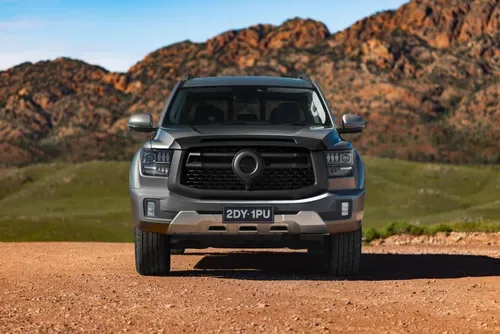
GWM is taking on the big guns in the South African bakkie market with a brand new 3.0-litre turbodiesel engine.
The Chinese carmaker announced pricing for the new 3.0-litre models, kicking off at R724,900 for the P500 Double Cab, and at R849,900 for the equivalent Tank 500 SUV.
Not only do these prices significantly undercut similarly powered rivals, like the Ford Ranger 3.0 V6 that starts at just over R1 million, but in the P500's case, the 3.0-litre model also costs R50,000 less than the previous 2.4-litre turbodiesel model.
If you’re going to take the bakkie wars seriously, you’re going to have to deliver the power and torque where it matters the most, and that is exactly what GWM appears to be doing with its new 3.0-litre turbodiesel engine.
For starters, the new 3.0-litre motor is the most powerful non-hybrid four-cylinder turbodiesel engine available on the market.
It produces 170kW of power and 620Nm of torque, which is 35kW and 140Nm more than the current 2.4-litre unit . This means it comfortably out-powers the Toyota Hilux 2.8 GD-6 (150kW, 500Nm) and Isuzu D-Max 3.0 (140kW, 450Nm); it even delivers more torque than the 600Nm Ford Ranger 3.0 V6, while coming close to its 184kW power output.
The new engine is paired with GWM’s in-house-developed nine-speed automatic transmission.
The new 3.0-litre turbodiesel motor will be exclusive to the P500 and Tank 500 models.
Exact local specifications had not been confirmed at the time of writing, but for the equivalent Australian versions, GWM claims combined fuel consumption of 7.1 litres per 100km in the Tank 500 and 7.3 l/100km in the P500. Both models have a braked towing capacity of 3,500kg.
The new engine has undergone more than six months of local engineering across a variety of local Australian roads, with testing focused on performance, durability, drivability, powertrain calibration and towing capability.
5News aggregated this summary from the outlet’s public feed. The full article, with all the context, is on iol.co.za — the content belongs to IOL.