SA and Canada should ‘boost resilience’ while diversifying beyond US
South Africa and Canada should use their position as middle powers to build stronger economic and diplomatic coalitions as the US increasingly uses its market power to extract concessions from trading partners.
Addressing a seminar on South Africa/Canada relations, MTN chair Mcebisi Jonas and Canadian high commissioner James Christoff said more dialogue and co-operation were needed in the face of global geopolitical shifts.
US President Donald Trump has imposed a 50% tariff on $27.6bn of Canadian goods, prompting Prime Minister Mark Carney’s government to announce matching duties from September.
South Africa has faced a 30% US tariff on its exports since August 2025, forcing Pretoria to accelerate efforts to diversify markets and reduce its exposure to a trading relationship dominated by a single major economy.
The pressure is reinforcing a broader reassessment among countries that lack the economic or military weight of the US and China but have enough resources, markets and diplomatic influence to shape other international outcomes.
For Canada, that argument has become central to Carney’s foreign policy. In a January address at the World Economic Forum in Davos, the prime minister said middle powers should act collectively rather than compete for the favour of larger powers.
He argued that the global system had undergone a rupture and that countries such as Canada needed to build greater strategic autonomy.
That vision is increasingly relevant to South Africa, which has sought to maintain relations with the US, China, Europe, Russia, India, the Gulf countries and other African countries while resisting pressure to align permanently with any geopolitical bloc.
At the Nucleus Institute Seminar, Deputy Minister of Trade,Industry and Competition Zuko Godlimpi argues that the inclusion of the DA in government has moderated their stance on critical issues such as trade relations with China and the green transition. @BDliveSA pic.twitter.com/WCMFWdGtxz
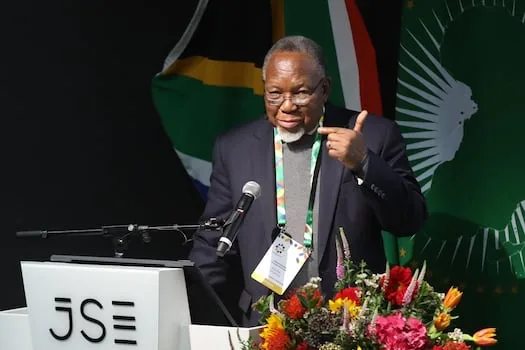
Jonas, a former deputy minister of finance, said South Africa’s objective should not be to replace one dominant partner with another but to build relationships that expand its room for manoeuvre and strengthen its ability to pursue economic development.
“The task is not to choose our one partner to replace the other…. It is to build relationships that increase our room to manoeuvre and strengthen our developmental capabilities,” he said during the Nucleus Institute seminar on Thursday.
He argued that the country’s middle power strategy would ultimately stand or fall on its domestic economic capacity.
A capable state, reliable infrastructure, energy security, stronger institutions and the ability to negotiate and implement trade agreements were prerequisites for diplomatic influence, he said.
Jonas also argued that South Africa should stop treating its role on the continent as one of speaking on behalf of Africa. Its leverage would be greater when it worked with other countries to aggregate economic power, particularly in critical minerals, infrastructure, energy and trade.
5News aggregated this summary from the outlet’s public feed. The full article, with all the context, is on www.businesslive.co.za — the content belongs to Business Day.