VOTE WITH YOUR FEET: Beyond potholes, Joburg needs permission to dream bigger
Fix Joburg’s potholes, traffic lights and water supply. But give me something else too. Give me more reasons to believe.
I have become increasingly obsessed with Joburg’s streets. Not for their artistic texture, potholes or uneven grading, but because sometimes the distance between feeling welcome and feeling unwelcome in a neighbourhood is just one block.
I was thinking about this at Main Street Sundays in early August, an Open Streets activation with Jozi My Jozi and Young Urbanists, with whom we partner in downtown Joburg.
There was music, food, children playing, people walking. And then, at one point, a Metro cop picked up a drum and joined the band.
He was good. Really good. For a few minutes, the uniform seemed to disappear. So did the line between authority and citizen. He was simply another person in the street, inspired to make music with everyone else.
It was a tiny moment, but it made me think about who gets to feel that a city belongs to them.
We talk about access as though it means simply being able to get somewhere. It is about whether the street feels safe, and you can walk it. It feels like a real luxury to suggest this – but it’s also about whether there is somewhere to sit. Whether there is shade. Or, in a city of speeding taxis and chance-taking drivers, whether you can cross the road without taking your life in your hands. But it is also much more than that.
The best expression of access is about whether you feel entitled to be there. Whether the city says: you belong here.
These are not new ideas. In Cape Town a series of street experiments by Young Urbanists has opened the possibility to imagine a different city. Crashing back down to our reality, a badly maintained pavement is a barrier. So is a dark street, and a road designed entirely around cars.
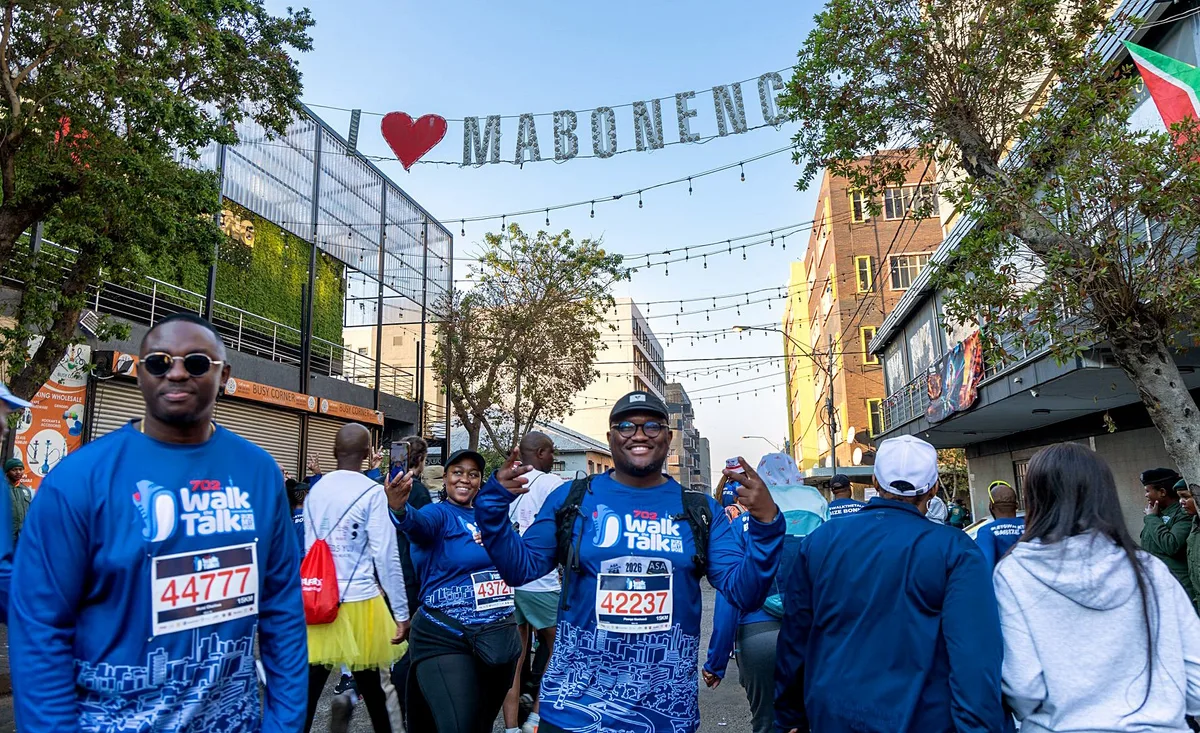
At the recent Jozi My Jozi 702 Walk The Talk, I joined 25,000 people to walk through the city. For 8km, I kept wondering: where were the people who live along that route? Why don’t they feel as if they have the right to be on these streets?
If we want a city that belongs to its people, participation can’t be something we stage occasionally. It must be built into the way we think.
I visited Colombia last year and was struck by the way cities such as Bogotá and Medellín have used transport and street interventions as tools for social inclusion. Coming out of an era of drug cartels and intense violence, they have fought their way back by making it a goal to connect isolated, low-income neighbourhoods to urban centres, reclaiming public space for pedestrians and consciously bridging historical social divides.
Medellín's Metrocable reaches some of the city’s most isolated hillside communities with an aerial cable car system that is included in the price of a metro fare. In one nightlife district we watched as roads were shut down to cars at sunset and streets opened to pedestrians only. Each week Bogotá’s Sunday Ciclovía closes more than 100km of roads to cars.
These aren’t simply transport projects. They change who gets to move through the city, and how.
5News aggregated this summary from the outlet’s public feed. The full article, with all the context, is on www.dailymaverick.co.za — the content belongs to Daily Maverick.