Kidnap victims escape 'hellfire' captivity with deep scars
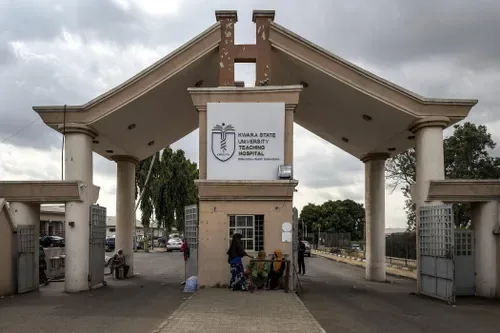
The entrance to the Kwara State University Teaching Hospital in Ilorin, Nigeria this week. It's patients, from Woro village, were among 308 people the Nigerian government said were rescued from suspected jihadist captivity in the Kainji Lake National Park forest bringing one of the region’s most harrowing mass kidnappings to a close.
Frail and malnourished children and women lay on rows of hospital beds, their bodies bearing the scars of six months of captivity deep in the Nigerian bush.
The patients were among 163 kidnapping victims rescued this month in the Kainji Lake National Park forest, after their village, Woro, was attacked by suspected jihadists.
Some 308 people were freed in what the government called the largest single day rescue operation. But at the Kwara State University Teaching Hospital in Ilorin, a long road to recovery lay ahead.
A child lay beneath a blue sheet, hooked to a respirator, with doctors and nurses clustered around the bed.
A sobbing girl, no more than six years old, sat alone on a bed, her family yet to visit.
"They are all responding to treatments," a nurse said, holding the tiny hand of a young boy about four years old. "Some of them still need blood."
Suspected jihadists attacked Woro, near the border with Benin, in February, killing at least 165 people and kidnapping scores.
Abductions have become a key moneymaker for criminal groups in Nigeria, especially among jihadists and non-ideological bandit groups across the north and centre of the country.
The victims were kept at a camp along with more than 100 others seized from other villages, including Kasuwan Daji and Konkoso, both in Niger state, Woro village head Umar Bio Salihu said.
Thirteen people from Woro died in captivity, he said, and 13 more remain in captivity.
Interviews with victims in the hospital were brief and stymied by officials who repeatedly bounced journalists between different offices to seek approval.
The government has touted the rescue of the Woro villagers as a major success in its campaign. But it still faces a crisis as kidnappings have become so rampant across the country that they have become a multi-million-dollar industry, according to SBM Intelligence, a Lagos-based consultancy.
"We thank God we are out," one gaunt victim, Hajara, said. "I do not wish that on even my enemies. It was like we just came back from hellfire."
5News aggregated this summary from the outlet’s public feed. The full article, with all the context, is on iol.co.za — the content belongs to IOL.