When a Country Celebrates its Women but can't Protect Them
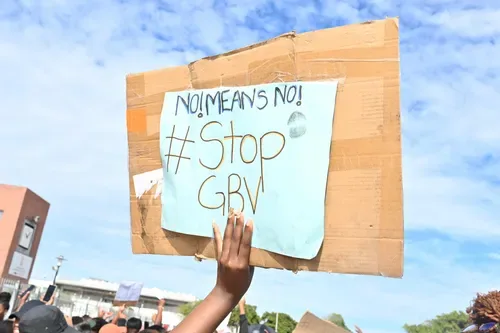
A placard calling for an end to gender-based violence during a protest outside a Khayelitsha court against the bail application of a man accused of rape and murder.
We remember the courage of the women who marched to the Union Buildings in 1956. We speak of dignity, equality, empowerment and the indispensable contribution women have made to our country.
Government departments hold commemorations. Speeches are delivered. Campaigns are launched. Women are praised as mothers, leaders, professionals, workers and nation-builders.
Yet behind these celebrations lies an uncomfortable and devastating contradiction: How can a country claim to honour its women while so many continue to live in fear of violence?
Gender-based violence and femicide remain among the most disturbing wounds in South African society.
Women are assaulted, abused, violated and killed, often by people they know and in places where they should feel safest.
We have legislation dealing with domestic violence and sexual offences. The legal framework has repeatedly been strengthened. In 2022, further legislation aimed at strengthening the fight against gender-based violence was signed into law, including amendments to domestic violence and sexual-offences legislation.
Then, in 2024, the National Council on Gender-Based Violence and Femicide Act was signed into law. Its purpose includes strategic leadership, coordination, monitoring and a national commitment to building a society free from GBV and femicide.
There are victim-friendly facilities and programmes.Government itself reported in late 2025 that SAPS had 176 Family Violence, Child Protection and Sexual Investigations units nationally and 1,161 designated Victim Friendly Rooms at police facilities and other sites.
But they force us to confront the real question: If the laws exist, the policies exist, the institutions exist and the promises exist—why do so many women still not feel safe?
The problem is whether the State can translate legislation into protection.
A law written in Parliament does not protect a woman unless it works in the street, in the police station, in the courtroom and, critically, before violence occurs.
A strategy is meaningless to a woman who fears the person waiting for her at home.
A campaign slogan cannot substitute for effective policing, investigation, prosecution and prevention.
5News aggregated this summary from the outlet’s public feed. The full article, with all the context, is on iol.co.za — the content belongs to IOL.