Cape’s magical kingdom | Where the mountain meets the sea
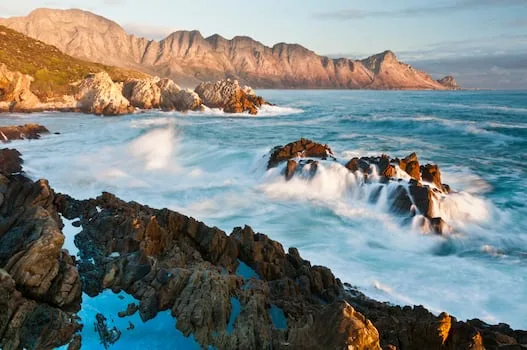
The stretch of coastline from Gordon’s Bay through Rooiels and Pringle Bay towards Betty’s Bay is one of those places that needs no introduction. You just have to look.
The mountains rear up in that world famously dramatic Western Cape way; False Bay sparkles below in the crisp light; baboons patrol the road with the proprietorial air of residents giving interloping tourists the middle finger; sugarbirds, sunbirds, rockjumpers and raptors appear overhead; and fynbos covers every nook of the slope.
Rooiels on the False Bay coast is tiny. Blink and you’ve passed through it. But this minute settlement sits at the entrance to something more important (and here I imagine David Attenborough’s voice in my head): the over 100,000ha Kogelberg Biosphere Reserve, recognised by UNESCO in 1998 as South Africa’s first biosphere reserve and widely regarded as the heart of the Cape Floral Kingdom.
The smaller 18,000ha Kogelberg Nature Reserve contains around 1,800 plant species, approximately 150 of them endemic — plants that exist here and nowhere else on Earth. There are King proteas and Kleinmond proteas, ericas, restios, rare Mimetes, and flycatcher bushes. There’s even a plant called King Gustav’s sceptre, which sounds like an object Indiana Jones might be excavating in an overgrown temple, not something you’d find on a hiking trail.
Fynbos doesn’t really get its due apart from the local gin industry. From a speeding car it can look like scrub. It doesn’t offer the drama of a baobab or redwood or the exoticness of a tropical rainforest full of bright creatures. But when you look properly, anonymous bushes begin separating themselves into ericas, restios, proteas and bulbs, and plants that survive in only a handful of places on the planet — we’re still discovering them.
Last year, CapeNature and members of the Custodians of Rare and Endangered Wildflowers rediscovered Erica cunoniensis in the Kogelberg Nature Reserve. The endangered species hadn’t been seen for nearly four decades and had been feared lost. Eight plants were found sitting on a mountain.
Dine van Zyl was thoroughly charmed. The author and journalist has lived in Rooiels since 1989 and investigates her stomping ground daily on foot. She and Graham McCleland document the plants and animals they find. Van Zyl talks about her discoveries with delight.
After the 2017 fire, she was walking a familiar route when she found a large stand of the endangered yellow Erica patersonii . She’d lived in the area for nearly 30 years and had never seen it. The taller vegetation had hidden it; fire uncovered it. She’s also discovered plants that books insist belong elsewhere.
“Hello, we’ve got it here,” she sings, proprietorially. Another plant, supposedly limited to a different part of the Hangklip coast, receives the same cheerful rebuttal: “Hello? It’s right here.”
On one recent two-day survey of the WWF South Africa property in the area — held in trust and managed by CapeNature — 136 research-grade plant species were recorded. McCleland estimates that around 250 plant species occur on that property alone, alongside leopards, caracals, honey badgers, Cape rockjumpers and ground woodpeckers.
5News aggregated this summary from the outlet’s public feed. The full article, with all the context, is on www.timeslive.co.za — the content belongs to TimesLIVE.