Cost of winning: The big business of SA schoolboy rugby comes with red flags
From a booming talent pipeline to unprecedented investment, junior rugby is flourishing, but it does have troublesome aspects.
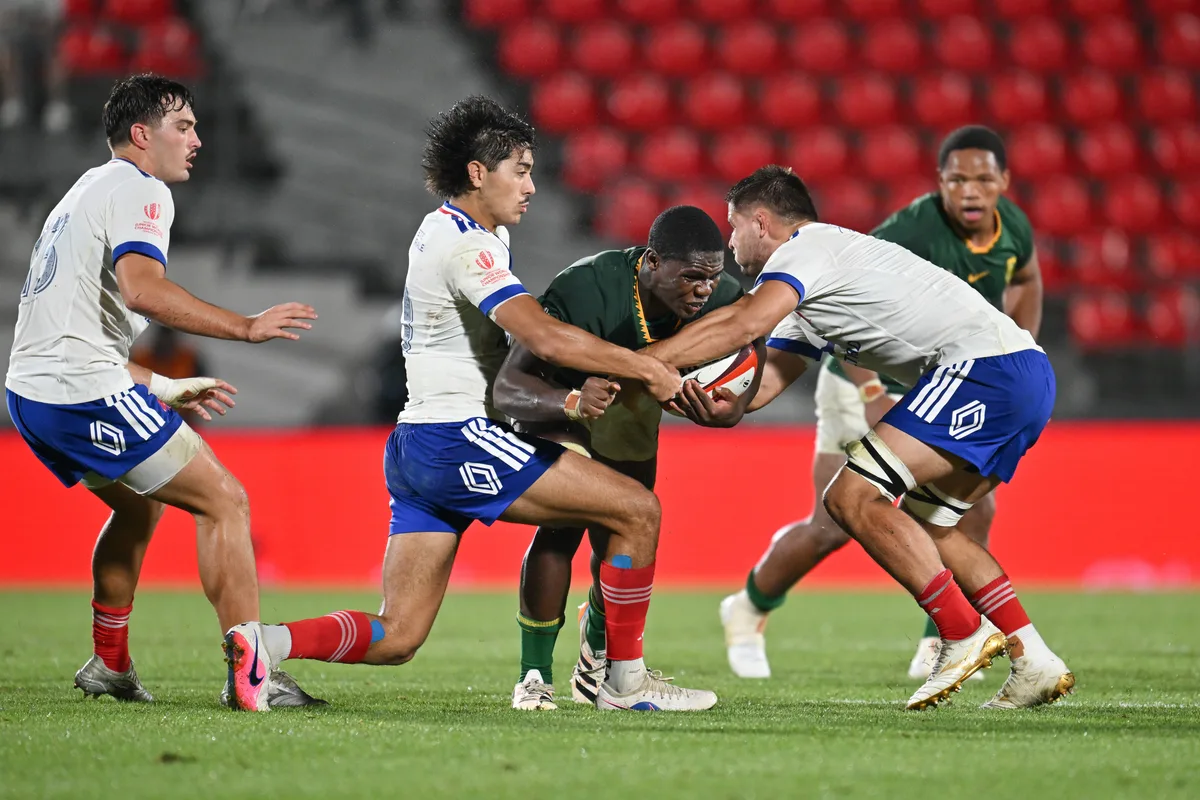
In July, the Junior Springboks made history when they claimed back-to-back Junior World Championship titles, beating France in a nervy final. A month later, in the Under-18 International Series, both South African teams (SA U18 and SA U18 “A”) completed their campaigns unbeaten, the first time in the competition’s history that both teams had done so in the same campaign.
These results, amid the dominance of the senior Springbok structures, reinforced what many in the game already believe – that South Africa’s school rugby system appears sounder than ever.
Lwazi Zangqa, the head coach of the SA U18s, credited the schoolboy system after his side’s dominant campaign, which included victories over France (52-7), Ireland (51-15) and England (68-40).
“We as selectors and coaches probably have the easiest job in just identifying the talent, but this is bred through many years of school pre-seasons, off-seasons and in-seasons,” said Zangqa. “It would be an injustice not to acknowledge how much South African schools’ rugby programmes contribute towards the pathway of what South African rugby can produce.”
School rugby has evolved into one of the country’s most influential sporting ecosystems, producing elite talent and serving as a critical pathway. It also attracts significant investment and draws crowds that many professional competitions would envy.
“Rugby is part of the South African DNA,” said Jeppe first team coach Drickus Venter. “In my opinion, South Africa has the best schoolboy rugby system in the world. The competition is fierce and there are some quality schoolboy coaches and some serious rugby programmes around.”
The quality and depth of schoolboy rugby is remarkable, and with more than half a million registered players, according to SA Rugby’s 2024 annual report, it is only going to get better.
The country has always had a proud tradition of powerful schoolboy rugby and the pool of competitive first teams has grown in recent years. Paarl Boys’ High, Paarl Gimnasium (Gim), Grey College, Paul Roos, Affies and Oakdale have been the top teams for some time.
Rondebosch Boys’ High, Jeppe Boys, KES, Sacs, Waterkloof, Durban High School, Grey High, Boland Landbou and others also regularly produce good teams and quality players.
In 2025, Stellenberg were marked as an up-and-coming side. And yet, few could have predicted that they would win 16 of their 18 games in 2026, beating Gim (20-19), Grey College (26-21), Paul Roos (20-10) and Oakdale (15-13) to get a top-four national ranking.
“Our talent pool is deeper than we think,” said Venter. “Talent isn’t just at the prominent rugby powerhouses in our country any more. The top-tier schools will always be very competitive and have bigger budgets and greater resources, but the gap has closed.
5News aggregated this summary from the outlet’s public feed. The full article, with all the context, is on www.dailymaverick.co.za — the content belongs to Daily Maverick.