Earth’s tides are shaped by more than the Moon. And they’re changing as the planet warms
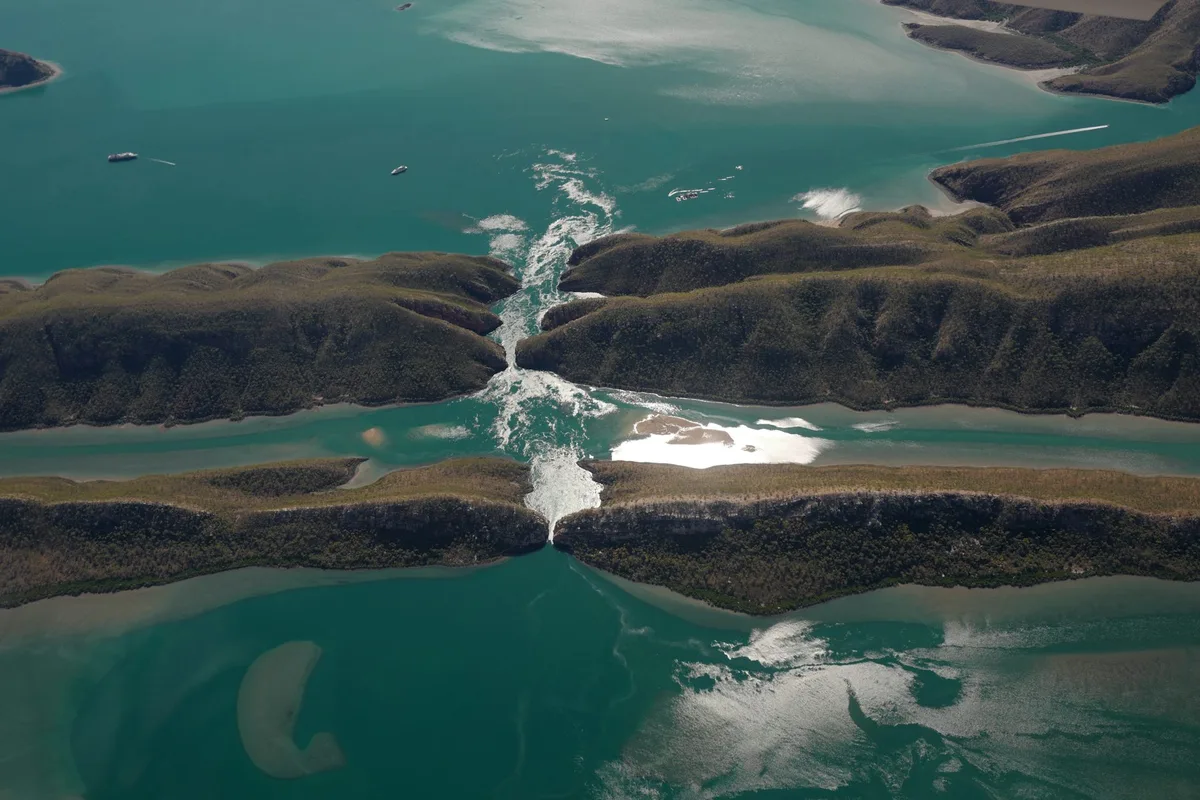
The Horizontal Falls are an unusual natural phenomenon on the coast of Western Australia's Kimberley region, where tidal flows cause waterfalls on the ebb and flow of each tide.
James D.
Morgan/Getty Images In some parts of the world, the sea barely rises and falls with the tides.
In others, the difference between high and low tide is dramatic.
Along Western Australia’s Kimberley coast , for example, it can exceed ten metres – roughly the height of a three-storey building.
Ocean tides shape coastlines and marine ecosystems, affect coastal communities, and even influence the melting of Antarctic ice shelves .
But why are tides so large in some places and so small in others? And as our oceans change, will the tides change too? The pull of the Moon and Sun The Moon and the Sun both produce tides on Earth through their gravitational pull.
Although the Sun is far more massive, the Moon is much closer, so it has a stronger influence on our ocean tides.
The Moon’s gravitational pull decreases with distance.
It is strongest on the side of Earth that’s closest to the Moon, and weakest on the far side.
This difference stretches both the solid Earth and oceans.
But because water moves more freely than rock, the effect is most visible in the ocean.
Ocean tides are the regular rise and fall of sea level driven by the gravitational pull of the Moon and the Sun.
This video shows tidal elevation amplitude simulated by a global tide model around Australia (green equals higher than mean sea level while blue equals lower than mean sea level) In a simplified picture, this creates two broad tidal bulges.
5News aggregated this summary from the outlet’s public feed. The full article, with all the context, is on theconversation.com — the content belongs to The Conversation Australia.