The Lindsay Clancy army, from mums in pink to right-wing podcasters
New York : For the past month, in an obsessively watched trial testing the insanity plea, Lindsay Clancy’s lawyer, Kevin Reddington, has argued that his client murdered her children in a state of postpartum psychosis brought on by the negligence and mistreatment of her medical overseers.
The position has found an overwhelming degree of public support – largely among women who have identified with Clancy despite the severity of her illness and the barbarous nature of her response.
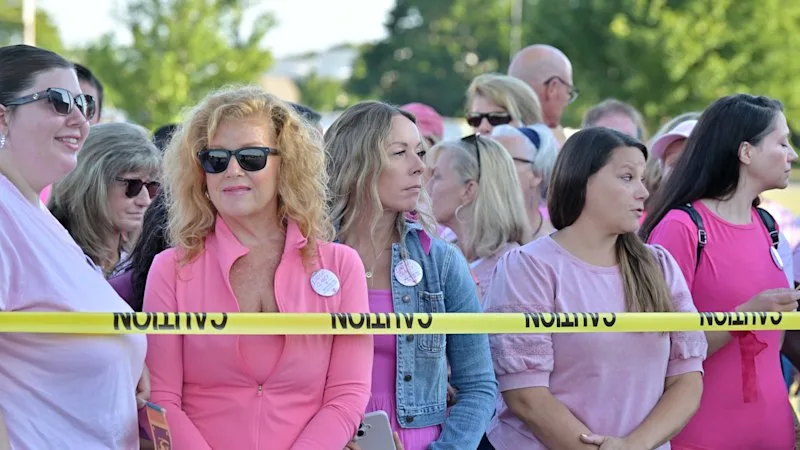
Hundreds have shown up outside the courthouse in Plymouth, Massachusetts, to rally for Clancy, a former labour and delivery nurse whose psychiatric care was so unco-ordinated, the defence maintains, that doctors subjected her to “horrific overmedication”, leading to dangerous auditory hallucinations.
“Any one of us who have dealt with mental health, anxiety, depression, postpartum – I think we just know that any one of us could be sitting in her chair,” Renee Kimball, the lead organiser of the rally, told a local news outlet. The gatherings were inspired by a call she posted on social media asking people to “stand in peace for Lindsay”.
Online, a kind of consensus certainty quickly emerged around the notion of Clancy’s victimisation. Any serious reckoning with the central brutality – that Clancy strangled her daughter, Cora, 5, and sons Dawson, 3, and Callen, 8 months, with exercise bands in their basement – has been subordinated to the compassion for her underlying anguish.
In some corners of TikTok and Instagram, where charitable feeling for Clancy is at a high pitch, unhinged conspiracy theories – born perhaps of the challenge in believing that a mother could do such a thing – suggest that maybe it was someone else behind the killings, even if Clancy has admitted to them.
On Etsy, there are at least 25 different kinds of pro-Clancy T-shirts available for sale. (“Team Lindsay!” reads one.)
The sympathy extended to Clancy recalls the allegiance offered to Luigi Mangione, who has admitted to killing Brian Thompson , the UnitedHealthcare chief executive, on his way to a meeting in midtown Manhattan. Many found the source of Mangione’s professed rage – an insurance industry perceived to be enriching itself on a hilltop of denied claims – all too relatable. As it is with Clancy, supporters regarded the system as a greater danger than the violence itself.
Part of Clancy’s care was undertaken at McClean Hospital in Belmont, Massachusetts, considered one of the world’s leading psychiatric facilities. But confidence in American institutions across the board, sits at record lows, and in the medical system at its lowest point since 1993, according to a recent Gallup poll. To some extent, that baseline of scepticism may challenge any effort to consider that Clancy’s doctors might have been doing their best.
In the instance of Mangione, reaction tended to groove with political leaning, the right regarding any support for him as debased – another instance, arguably, of society’s shift toward anarchy.
5News aggregated this summary from the outlet’s public feed. The full article, with all the context, is on www.smh.com.au — the content belongs to Sydney Morning Herald - World.