NZ’s fastest growing town was once the future of urban planning. What happened?
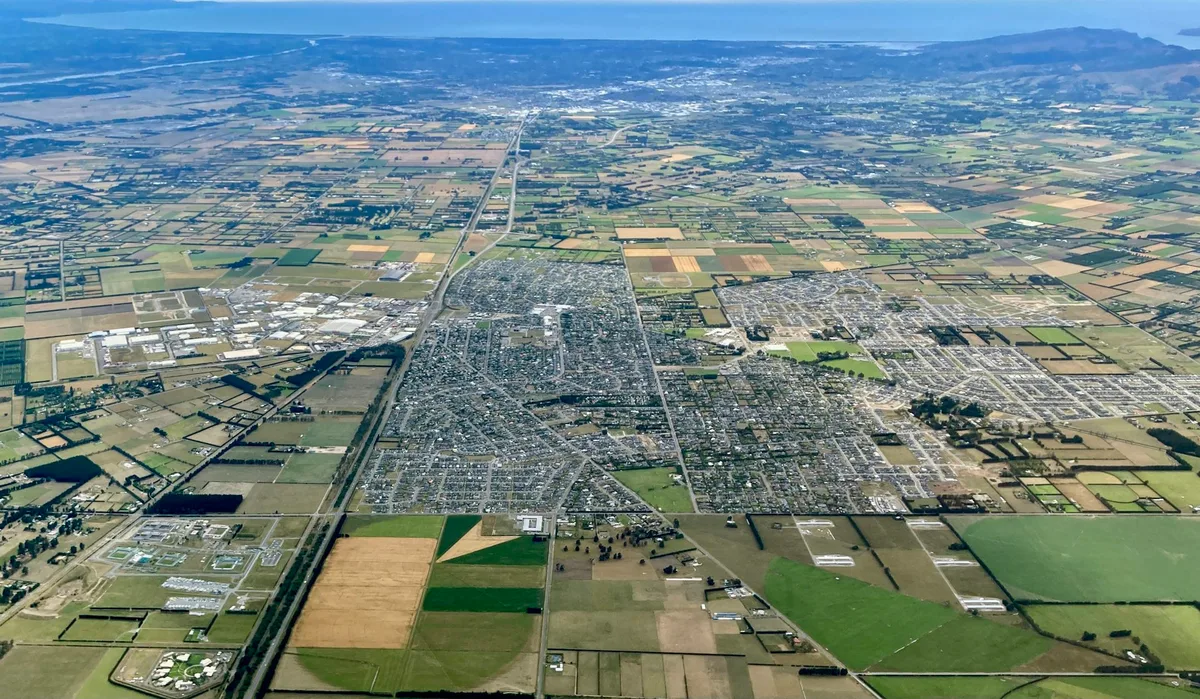
Mike Dickison/Wikimedia , CC BY-NC-SA Travel 25 kilometres south from Christchurch on the new 110 kilometre-per-hour, multi-million-dollar “road of national significance” and you’ll reach New Zealand’s fastest growing town .
Situated within the country’s fastest growing district of Selwyn, Rolleston now boasts a population over 34,000 – predicted to reach 50,000 by 2050.
It is already Canterbury’s second-biggest urban area, surpassing Timaru and Ashburton.
Rolleston was growing fast before the 2010–11 Canterbury earthquakes.
And its continued expansion – including a proposed large-scale housing development – is part of a national pattern of mushrooming, car-dependent satellite towns and fast-tracked urban sprawl.
From 2000 to 2025 the town grew by a staggering 1,246%, or 11% annually.
By comparison, New Zealand grew by 38% in that period, or 1% a year.
But the Rolleston that has evolved – largely a dormitory suburb of Christchurch built on once-productive land – is very different to the town first envisaged by planners in the early 1970s. ‘Town of the future’ According to the 2023 census , 52.9% of Rolleston’s residents commute to Christchurch for work, compared to the 32.4% living and working in the town.
As my research has found , this was not the original intention.
In November 1973, the Labour government of Norman Kirk announced the controversial purchase of 10,000 acres (4,000 hectares) of land to develop a town for up to 50,000 people.
Influenced by postwar international trends for new towns, the ambitious “town of the future” project was intended as a solution to Christchurch’s growing population.
A separate, planned town would help preserve the city’s greenbelts, avoid urban sprawl and encourage economic and population growth in the South Island, away from Auckland in the north.
It was hoped the town would be “as self-sufficient as possible in terms of industries and recreation to avoid adding further to the problems of Christchurch”.
The planning work was careful, progressive and informed by international examples.
5News aggregated this summary from the outlet’s public feed. The full article, with all the context, is on theconversation.com — the content belongs to The Conversation Australia.