Pirates were far more diverse than Blackbeard. And they didn’t say ‘arrr’, matey
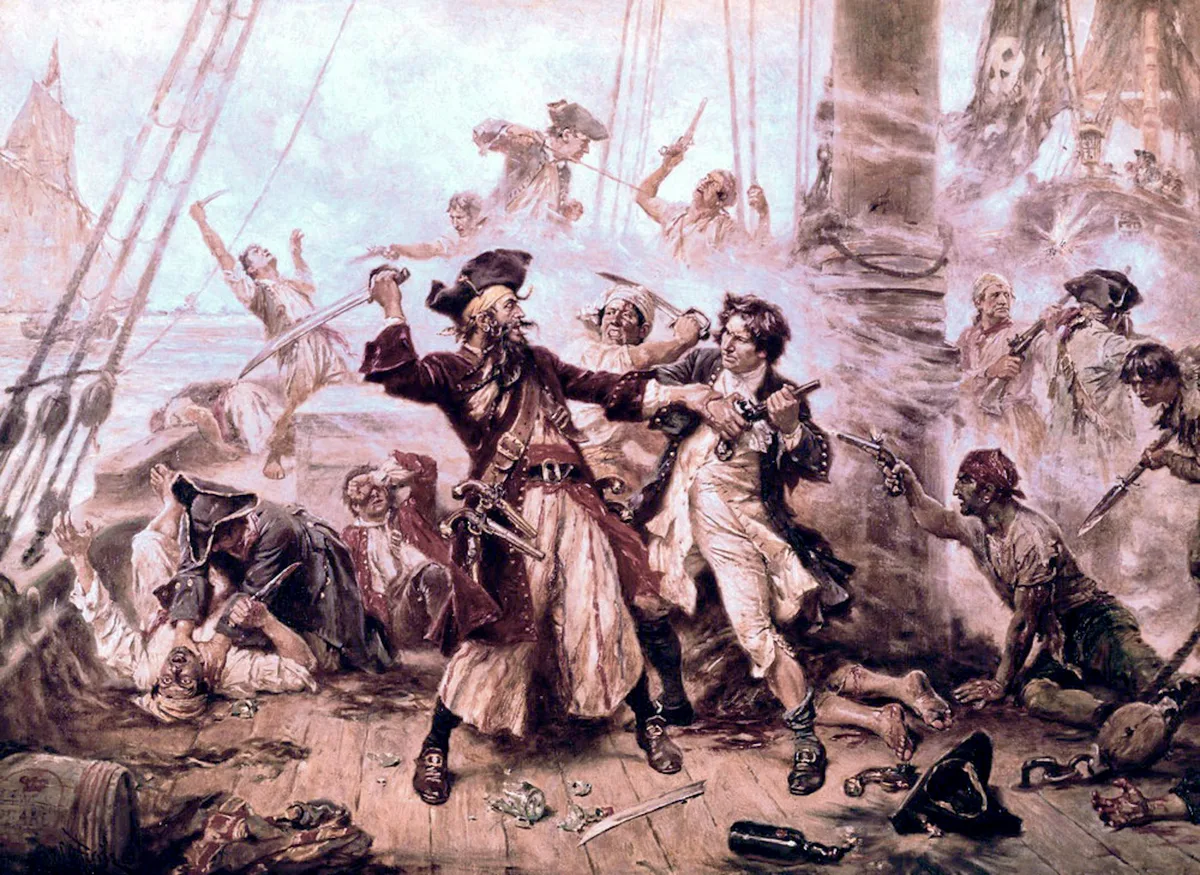
Jean Leon Gerome's 1920 artworks _Capture of the Pirate, Blackbeard, 1718_, depicting the battle between Blackbeard and Lieutenant Maynard in Ocracoke Bay.
September 19 marks International Talk Like a Pirate Day , an annual event that sees children and adults the world over play pretend, usually by donning a long coat and leather boots – perhaps a cutlass – and a wig of long, unruly hair spilling out from under a tricorne hat .
And saying “arr” a lot, of course.
As a pirate historian , I’m sorry to report this vision is disappointingly limited.
While popular culture has settled on a narrow stereotype, the oceans were once crowded with all manner of pirates – from Caribbean raiders, to Chinese fleet commanders and Southeast-Asian Muslim seafarers.
Blackbeard’s legacy The term “pirates” refers to people who launch attacks from the sea to take what isn’t theirs.
So labelling a group as such involves making a moral judgement about their activities, and characterising them as illegitimate.
In the early-modern era, from the 16th to 18th century, who was named a “pirate” came down to who was doing the naming.
Today’s popular depictions of pirates are influenced by real marauders, including Bristol-born Englishman Edward Teach (1680–1718), also known as Blackbeard, who featured in Captain Charles Johnson’s 1724 book A General History of the Pyrates .
Blackbeard and his ilk have played an outsized role in cementing our collective image of pirates, as has Robert Louis Stevenson’s 1883 novel Treasure Island .
Portrait of ‘Blackbeard the Pirate’ depicted with trademark millinery in the book A General History of the Pyrates (1724).
Wikimedia Blackbeard rose to infamy during the “golden age of piracy”, which roughly spanned the 1650s to 1720.
This era saw escalating pirate attacks on ships and settlements on Caribbean islands and the Atlantic coast of the Americas.
Pirates stole human captives, silver, gold, and whatever valuable objects they could grab.
5News aggregated this summary from the outlet’s public feed. The full article, with all the context, is on theconversation.com — the content belongs to The Conversation Australia.