Who’s paying whom? The circular money machine behind the AI boom (or bubble)
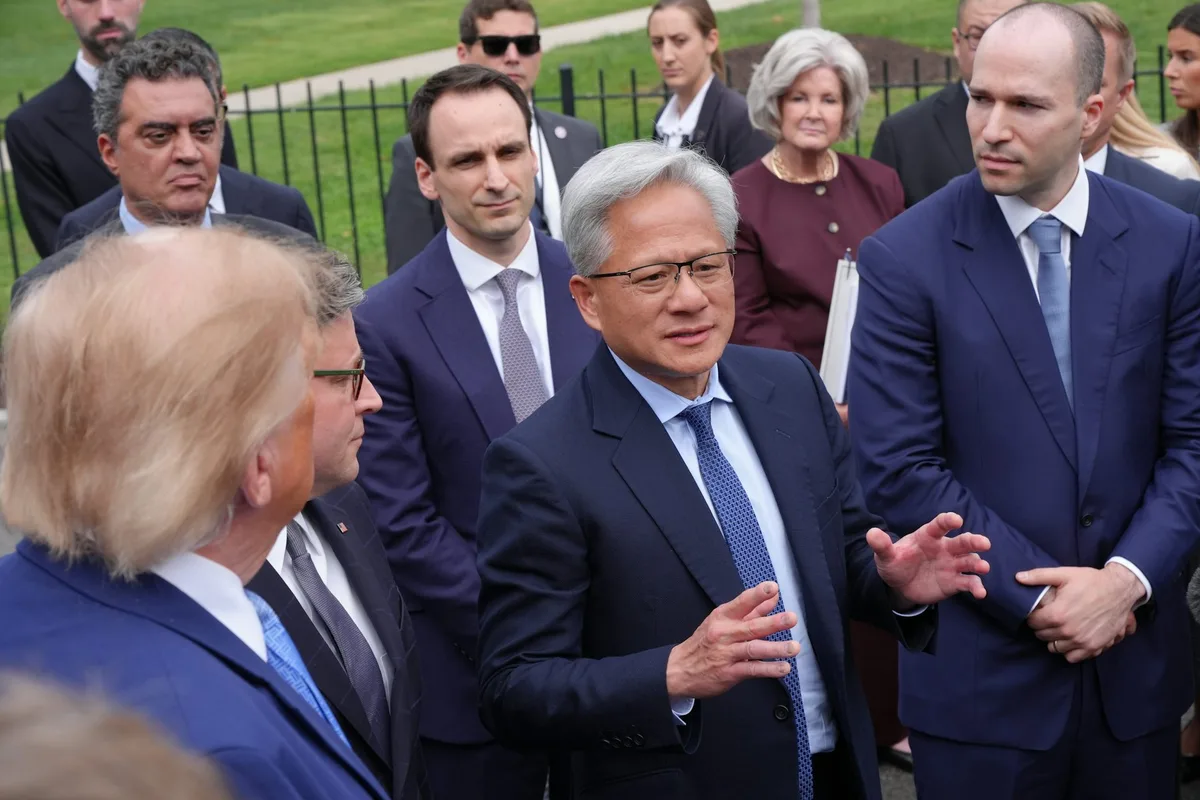
Nvidia chief executive Jensen Huang, centre, speaking at the White House.
OpenAI president Greg Brockman is on the right.
AP Imagine a company that sells you equipment, invests money in your business, and then rents back what you build with it.
It’s your supplier, your investor and your customer all at once.
That’s known as circular financing.
Many artificial intelligence (AI) companies, including Microsoft, Amazon, Google and Nvidia, have adopted a version of this opaque method of financing.
A chip supplier invests in a customer such as a data centre builder, the customer spends the money on the supplier’s chips, and both companies report growth.
One central bank analysis found that 55.2% of investments into AI firms came from other AI firms.
What’s not clear to investors or the market is how much of this AI boom is being driven by real, end-user demand — and how much might be a bubble.
It all comes back to Nvidia Take Nvidia.
The world’s leading chipmaker is investing in ChatGPT owner OpenAI to support data centres filled with Nvidia chips.
Nvidia will invest US$30 billion in a private funding round in OpenAI and provide a guarantee of up to US$105 billion for an OpenAI data centre in Ohio, as well as investing in the company building it.
That helps OpenAI to remain Nvidia’s best customer, but it also raises the question: is the chipmaker propping up the market? Nvidia has invested in other AI firms as well, including up to US$10 billion in Anthropic , the developer of Claude.
It bought US$2 billion of shares in cloud provider CoreWeave to help it speed up the build-out of AI factories that use Nvidia technology.
5News aggregated this summary from the outlet’s public feed. The full article, with all the context, is on theconversation.com — the content belongs to The Conversation Australia.