Housing with benefits: Why co-housing could be the new Australian dream
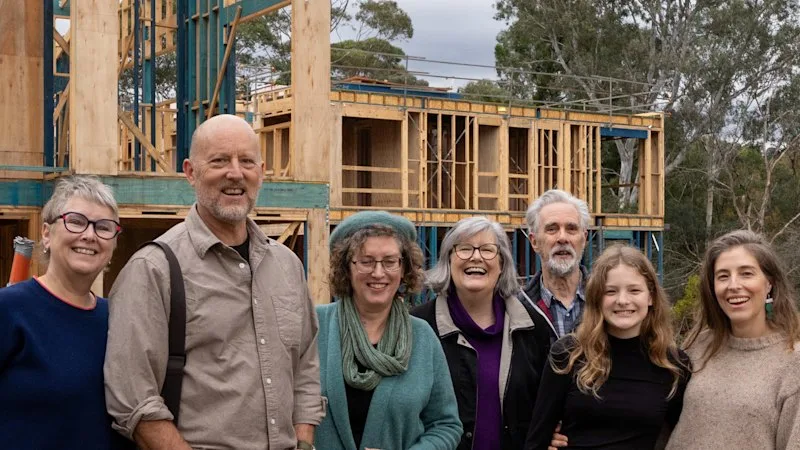
It was a conversation with their son who put words to something Ross and Paula Wade had always felt: the desire to live a little differently. They wanted to share a garden and were happy to live in a modest home in exchange for community.
They just didn’t think realising this dream would come with a $200,000 premium.
The Wades, a couple in their 70s, are part of a group of like-minded prospective home owners who want to live as part of a co-housing development.
Recent moves by the federal government to make property more affordable for younger people, such as restricting tax breaks for negative gearing to new builds, has opened the door to thinking about residential property in ways other than an investment. For Australians less concerned about asset price growth and more with building community, the changes signal a new way of living is possible .
Still under construction, the Brougham Street Collective in Eltham in Melbourne’s leafy north-east is already a collection of buildings surrounded by heritage-listed structures of various sizes. It’s planned to have no fences for privacy, no individual driveways and smaller houses.
It is set to have 20 homes, of two, three and four bedrooms, a shared garden, babysitting on-site, access to eco-friendly power, communal cooking and good friends of all ages.
“It’s magic, staying connected, not only within your own family but with a whole group of people who have become friends,” says Paula.
Council approval was a sticking point. Brougham Street failed to secure a permit because “planners just don’t have a model for this kind of development”, Ross says.
“It’s just a tick-box process [for the council]. We say we have a common house, they say, well, what’s a common house? I can’t see a box to tick for that.”
Brougham Street was forced to go to the Victorian Civil and Administrative Tribunal (VCAT) to overturn the council’s decision, adding about $200,000 in costs.
Ross says while the collective was not thrilled about the cost, the only other option was to abandon the project and sell the land.
“The whole community agreed that it was worth it to secure our dream of living in an intentional community together,” Ross says.
The co-housing model is more common in Europe, and originated in Denmark in the 1960s. The developments are generally small-scale communities of up to 50 households: resident-governed and -planned, rather than developer-led. Some have communal areas, although each community decides its format.
Caitlin McGee, UTS Institute for Sustainable Futures research director, says the motivation for co-housing participation was “largely around social connection”, as family structures change and people seek intergenerational support .
5News aggregated this summary from the outlet’s public feed. The full article, with all the context, is on www.watoday.com.au — the content belongs to WAtoday.