Some of the most iconic movie sets aren’t sets at all – they’re paintings
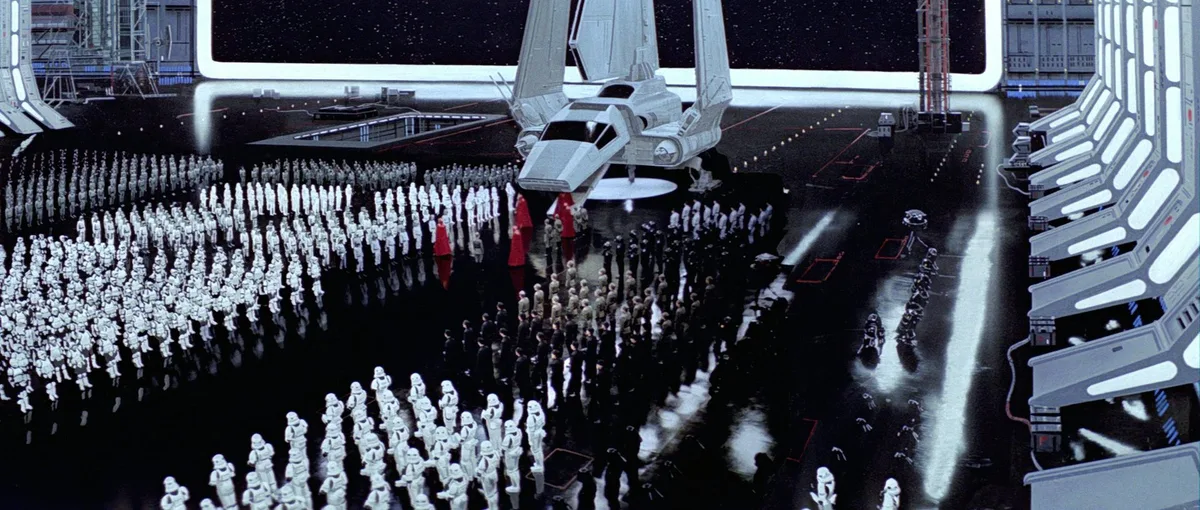
Star Wars: Return Of The Jedi / 20th Century Fox In the final moments of Steven Spielberg’s 1981 film Indiana Jones and the Raiders of the Lost Ark, the mystical Ark of the Covenant is stored in an enormous, box-filled warehouse.
How did the filmmakers create such a huge set? The truth is, there is no set: it’s a painting.
The technique of matte painting has been used in some of cinema’s most incredible moments – and it can leave you doubting what’s in front of your eyes.
What is matte painting? Matte painting involves combining live-action footage with still painted images to create a single, seamless image.
The technique is popular because it is able to create huge, convincing scene environments at a low cost.
Much of Blade Runner’s (1982) bleak world was matte painting created by artist Matthew Yuricich.
The secret sauce, though, is the talent of the individual painters, whose mastery of texture and shading produces convincingly photo-realistic images.
Matte painting does have limitations, though, such as restricting how much the camera can move.
Going too far out means transcending the painting’s boundaries and breaking the illusion.
This is why German director Fritz Lang used complex combinations of scale models and mirrors to create his science fiction world of Metropolis (1927).
Filmmakers over the decades have developed technical and creative techniques to use matte painting within more complex, moving shots.
Early matte painting One of the pioneers of matte painting in cinema was the silent film director Norman Dawn.
Dawn’s 1907 film Missions of California depicts various dilapidated mission buildings.
To “repair” these building, he painted their missing parts on a sheet of glass, and lined it up between the scene and the camera while filming.
5News aggregated this summary from the outlet’s public feed. The full article, with all the context, is on theconversation.com — the content belongs to The Conversation Australia.