‘Like a bomb exploded’: How an enormous chunk of ice likely triggered catastrophe
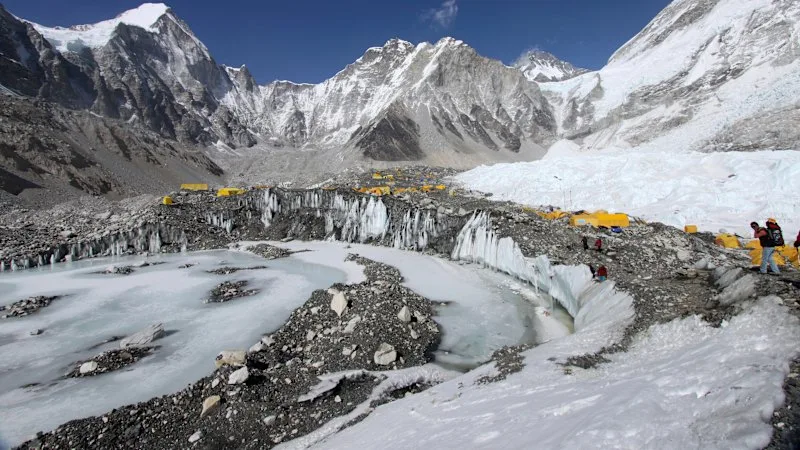
The deadly flooding in Nepal was likely set off at least in part by an enormous chunk of ice snapping off a glacier and cascading thousands of feet to the valley below, according to an initial assessment by a group of geologists and glaciologists. The phenomenon is known as an ice avalanche.
“It looks like a glacier in the area basically snapped off in a clean break, allowing it to fall just over a vertical kilometre to the valley bottom,” said Daniel Shugar, a geologist at the University of Calgary in Canada who studied satellite imagery to analyze what happened.
“The bottom looks like a bomb exploded — it’s just deposits from the broken-up glacier,” he said.
But he said that it was too early to rule out other possible factors behind the flash flooding. Hundreds of people are missing in Nepal and the Chinese territory of Tibet after floodwaters cascaded through river valleys on Wednesday morning. Warming temperatures caused by climate change may have accelerated the glacier’s collapse, scientists said, but they added that it was too early to determine a precise cause.
Across the fast-warming Himalayas, melting glaciers are presenting dangerous new opportunities for avalanches and earthquakes to cause destruction by unleashing torrents of water.
On Wednesday, chunk of ice with a width of about 600 metres snapped cleanly off the glacier, Shugar said, sending a mixture of ice and water to the valley floor. By his assessment, the chunk of ice fell from an altitude of about 5182 metres, dropping almost 1200 metres.
“This is a big chunk of ice that is stored at high elevation in the mountain, with a huge amount of potential energy,” said Simon Cook, a glaciologist at the University of Dundee in Scotland who also worked on the satellite analysis. When it breaks off, he added, the sheer force of the drop pounds the ice into a dangerous, fast-moving mix.
According to the group’s analysis, the glacier break occurred about 65 kilometres north of Kathmandu, and the flow of ice moved northwest along the valley toward the Bhote Koshi River, at the border between Nepal and the Chinese territory of Tibet.
Cook said the ice avalanche recalled a similar event in India in 2021, when a Himalayan glacier broke and caused major flooding in the northern Indian state of Uttarakhand, killing more than 100 people.
Kristen Cook, a geomorphologist at Université Grenoble Alpes in France, said that local seismic readers indicated that a large mass had suddenly moved downhill in the area around 8:40am local time. That was followed immediately by a “flow signal,” which indicates flooding.
“I see a signal that is quite large at the start of the event, but it does not look like an earthquake,” she said. “When we combine this with what we know about the area and satellite imagery, we come to a preliminary interpretation that this was most likely a rock-ice avalanche that transitioned into a flow as it moved downstream.”
The US Geological Survey initially recorded a 4.4-magnitude earthquake in the area around that time. But the agency later determined that the landslide itself had caused a seismic signal that was reported as an earthquake.
5News aggregated this summary from the outlet’s public feed. The full article, with all the context, is on www.brisbanetimes.com.au — the content belongs to Brisbane Times.