Posing as a 17-year-old girl online, I expected body image content. I got gender division
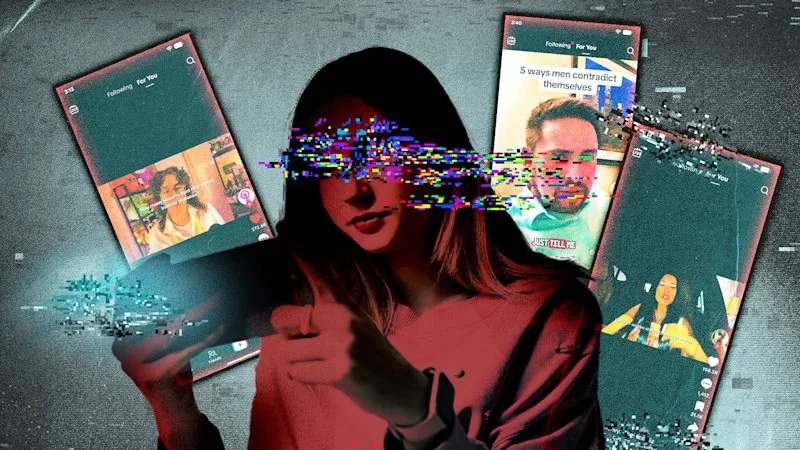
When I set up my fake profile of 17-year-old Olivia James, I expected my social media feeds to be flooded with body image content, “thinspiration” influencers, and beauty posts.
Instead, it took just half an hour to be shown content that stoked gender division – though this time, the content didn’t attempt to control the behaviour of the “other side”.
Last week, I posed as a 17-year-old boy on social media . Within 13 minutes of scrolling, my fake profile of Jaden Michael was shown content that led him down the manosphere pipeline, culminating in one post at the hour mark telling women to be as subservient to their husbands as they are “to their bosses”.
The federal government announced a crackdown on toxic content last week, requiring social media giants to allow Australian users to opt out of their algorithms. The reform is part of its digital duty of care bill that will force tech platforms to take reasonable steps to protect under-18s from misogynistic content, alongside posts that glorify crime or encourage terrorism, bullying or eating disorders.
Almost two-thirds of Australians aged 12-18 said social media made them feel dissatisfied with their body , according to the Butterfly Foundation. More than 90 per cent have some level of body image concern.
With this in mind, I replicated the experiment I ran for Jaden, passively scrolling on TikTok, Instagram, and YouTube Reels for 30 minutes before actively engaging with content by following a healthy-eating page, a notoriously thin celebrity, and two “thinfluencers”.
Again, YouTube Reels showed me poor-quality AI slop and ads. Instagram pushed an alarming number of videos featuring food and fruit chopping, but most posts were generic and lacked an agenda.
I tried to guide TikTok’s algorithm towards disordered eating content. Instead, it once more showed me the manosphere, this time from a different perspective.
Importantly, unlike Jaden’s feed, none of the content attempted to control the behaviour of the other gender, nor did it teach that one side was superior and the other subservient.
There were several posts criticising men’s behaviour. However, most content urged women to fight for their rights, identity and equality.
My experiment culminated in a reel featuring a speech by Ashley St Claire, a former right-wing influencer who was in a relationship with Elon Musk. St Claire said she was offered $40 million by Musk not to appear in a documentary about him. She said Musk deliberately stoked division on his platform X.
“He is stoking flames that don’t exist in the real world,” she said. “He is causing deliberate division that may be catastrophic if it’s not regulated or tamed, or if we don’t do our part in putting it down.”
A recent University of Melbourne study found roughly one third of teenage boys expressed misogynistic attitudes, mistrust of women, and a belief in “traditional” gender roles.
5News aggregated this summary from the outlet’s public feed. The full article, with all the context, is on www.watoday.com.au — the content belongs to WAtoday.