Now I weep: After decades working with Nepal, I see the root of its disaster ignored
Wednesday was just another day at Adara, the global humanitarian group I founded 28 years ago. The team in our Sydney-based “for purpose” corporate advisory firm, generating revenue for our work with people in poverty, was producing financial and commercial advice to significant Australian organisations. Our development teams in Sydney, Uganda and Nepal were working on maternal newborn health and remote education services. Then our phones began pinging.
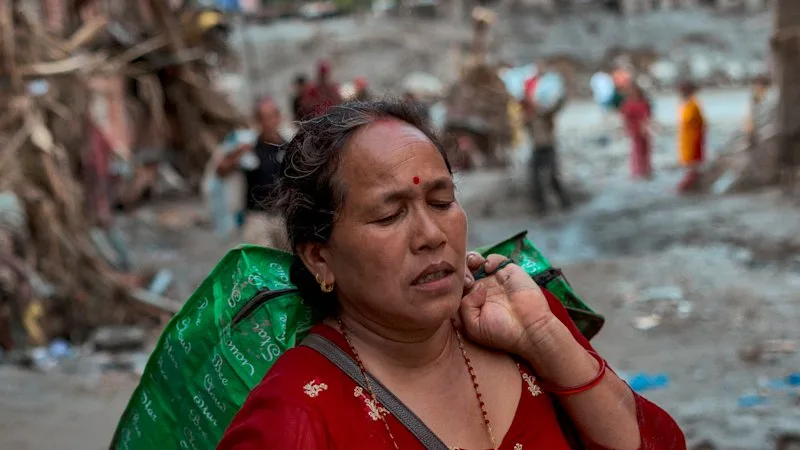
Messages came from Pralhad Dhakal, director of our Nepal operations. He had just landed back in Kathmandu from our most remote project sites in the country’s far west. His family lives in Nuwakot, the worst-hit region of the sudden floods, where we have been working for many years. He was just off a call from his sister as she fled to the mountains. He was worried about his elderly father, who lives near the Trishuli River. Yet still doing his job – checking in on his staff, their families and the communities we work with. Risk assessment. Staff assessment. Damage assessment. Leadership.
As we now know, a giant chunk of Himalayan glacier had broken off and plummeted thousands of feet, triggering a wall of water, mud and ice that swept into the Bhote Koshi and Trishuli rivers, which rose by up to nine metres in 30 minutes and poured into Nepal. Flooding ripped into the Nuwakot region, where we have been working for many years – a place massively damaged in the 2015 earthquake that took almost 9000 lives.
Here it was again. Unfolding catastrophe in a region of desperately vulnerable people. The glaciers, which tower over the breadth of northern Nepal, are recast in an instant – from nature we gaze at in awe, to nature we fear.
Researchers at the Kathmandu-based International Centre for Integrated Mountain Development say the region’s ice loss has doubled since 2000 . Even under the Paris Agreement’s best-case 1.5-degree pathway, roughly a third of these glaciers will vanish this century. On current trajectories, the Hindu Kush Himalaya could lose up to 75 per cent of its ice volume by 2100, drying up the rivers that feed a quarter of humanity.
This is the ugly face of climate change . In rich countries, we are living with it . In low-income countries, the poor are bearing its deadliest consequences.
What happened in Nepal should not be viewed as simply a distant tragedy. The dots connect. In Australia, our retreat from climate action continues. Executives returned to Australia from holidays in Europe, many talking about “how hot it was over there ”. And then, seemingly without a moment of reflection, they returned to business as usual – financial metrics, competitive pressures and reporting season. The very definition of missed opportunity as our world warms to the point of crisis .
Having worked for decades in the business sector as a director and adviser to large companies as well as in the humanitarian sector, I am used to head-snapping changes in approaches and views.
5News aggregated this summary from the outlet’s public feed. The full article, with all the context, is on www.brisbanetimes.com.au — the content belongs to Brisbane Times.