This is, hands down, the most confronting thing I’ve seen on screen all year
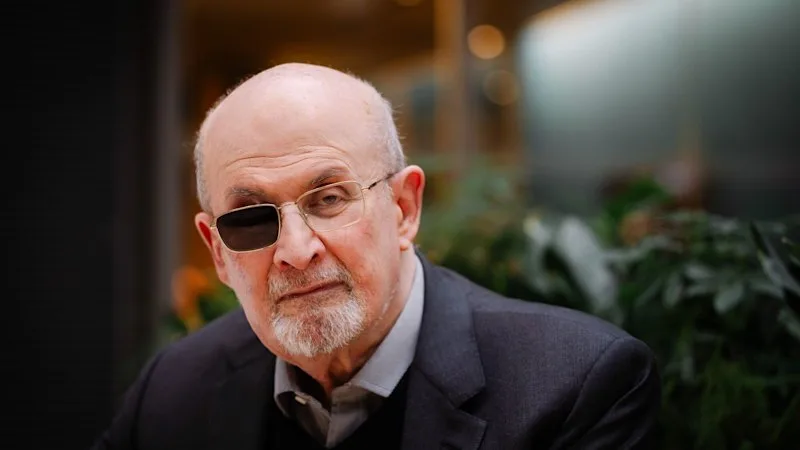
As Salman Rushdie lay in hospital after being repeatedly stabbed on stage in August 2022, his wife Rachel Eliza Griffiths started filming. Asking if he was OK with that, he told her yes. “We need to document this.”
Now, Alex Gibney has turned that raw, unflinching and often hard-to-watch footage into Knife: The Attempted Murder of Salman Rushdie , one of the most confronting, but ultimately hopeful, movies you’ll ever see.
“On this film, I acted mostly as an editor,” says the prolific documentarian who won an Oscar (with Australian producer Eva Orner ) for Taxi to the Dark Side in 2007 and has five Emmy wins to his name.
“My agent told me Salman and Eliza were interested in talking to me, and I learned they had this footage that Eliza took, starting on day five of his recovery and going right up to when they returned to the scene of the crime. And the first question I asked them was, ‘Why don’t you do it? No one knows more about what happened than you do’. And they said, ‘Well, that’s the problem. We feel too close to it. We want somebody else to come in and see if they can figure out a way to reckon with it.’”
Gibney pitched an approach informed by The Singing Detective , the 1986 BBC drama series written by Dennis Potter, in which Michael Gambon played a bed-bound writer in hospital whose medication produces a blurring of his imaginative world and his memories.
Despite its complex (and much-praised) structure, the show could be boiled down, says Gibney, to a pretty simple idea: a guy who is sick gets better, but along the way he reimagines his life through hallucinations and his detective fiction.
Rushdie, who had not yet decided to write his own account of the incident (his book Knife: Meditation on an Attempted Murder was released in August 2024), liked the idea, and the film Gibney has made – with Griffiths credited as executive producer and principal cinematographer – serves both as an account of the attack and its aftermath and as a meditation on Rushdie’s life more broadly.
Knife opens with a recreation of the attack, with Rushdie asking in voiceover, “Why didn’t I fight back?” It’s a shocking way to start, but it’s nothing compared to what follows.
The Booker Prize winner was in a chair on the stage of the Chautauqua Institution in New York State, about to be interviewed, when a man armed with a knife rushed up the steps and lunged at him. The attacker, Hadi Matar , stabbed the novelist 15 times, landing blows in his neck, stomach, chest and thigh. One of them struck Rushdie, who was 76 at the time, in his right eye (he has lost all sight in it).
Matar had been inspired by the fatwa issued by Iran in 1989 in response to Rushdie’s novel The Satanic Verses , which Ayatollah Khomeini and his fellow clerics had deemed blasphemous. (Iran’s position on the fatwa has since become somewhat ambiguous, but it has never officially been rescinded. Last month a trial on terrorism charges against Matar – who has already been convicted of attempted murder – began in Buffalo, New York.)
The film also includes real footage of the attack, which was only released during Matar’s first trial in February 2025.
5News aggregated this summary from the outlet’s public feed. The full article, with all the context, is on www.brisbanetimes.com.au — the content belongs to Brisbane Times.