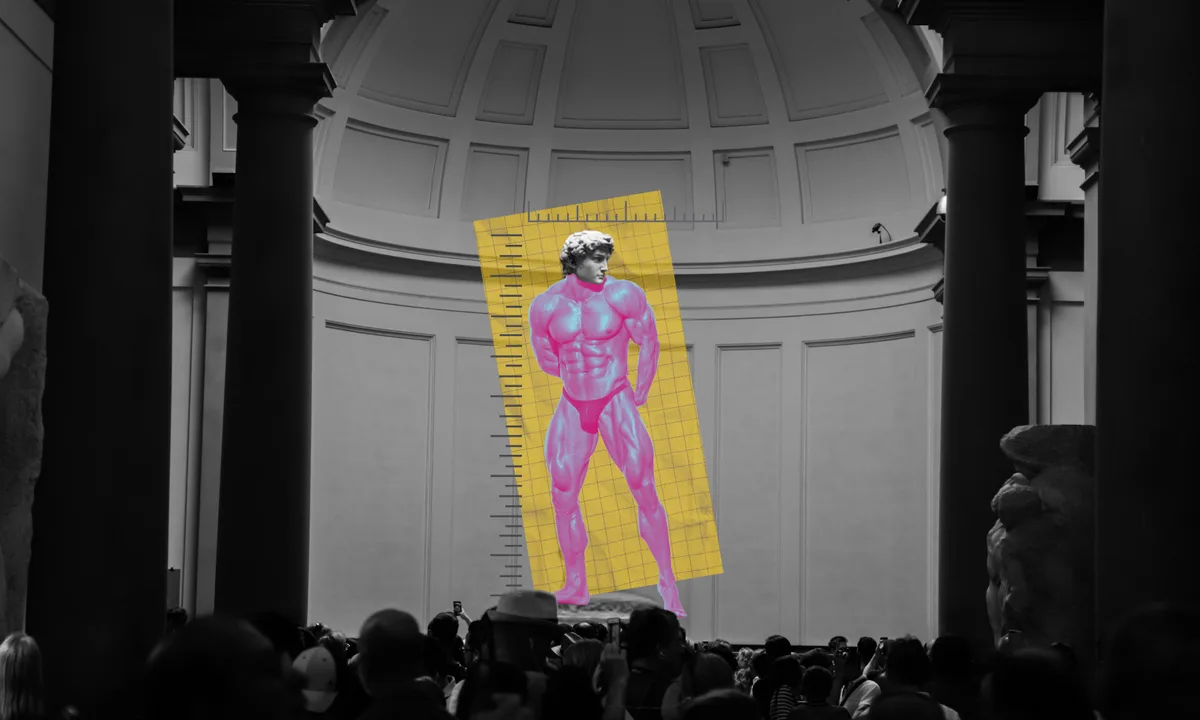
Would Michelangelo’s David pass a looksmaxxing audit?
The Conversation If you’ve ever ventured into the fitness corners of social media, you may have come across influencers peddling the ideal of a “Greek god” physique.
They may try and sell you supplements or programs to attain said ideal – or direct you to AI apps , like UMAX AI or Physiqmax, that purport to tell you whether or not you meet the standard.
Looking to ancient Greek sculptures as the paragon of fitness isn’t new.
In fact, bodybuilding as we know it may well have been founded on this basis.
It’s ironic, then, that this pursuit has drifted so far from its original aspirations that even Eugen Sandow, the so-called father of modern bodybuilding, wouldn’t recognise it.
Would Sandow, and the prized marble figures sought to imitate, pass a “looksmaxxing” audit today? The birth of bodybuilding Strongman Eugen Sandow was born in Prussia (modern-day Kaliningrad, Russia) in 1867.
While on a trip to Italy as a boy, he gazed at classical statues in Rome and decided to build his body to match.
He was also known to dust himself in white powder to mimic marble when he posed, thereby recreating himself as a classical sculpture on stage.
Through emulating Grecian statues, he signalled an ancient ideal.
The most balanced is the most beautiful The Greeks and Romans did admire physical beauty.
For men, this usually meant an athletic physique, an attractive face and tall stature.
For example, the Greek orator Dio Chrysostom (circa 40–110 CE) described athletes as “the tallest and most comely men”, whose “bodies receive the most perfect care”.
These ideals were also expressed in sculpture.
One famous example is the Greek sculptor Polyclitus’ 5th century BCE statue of the Doryphoros, or Spear-Bearer.
5News aggregated this summary from the outlet’s public feed. The full article, with all the context, is on theconversation.com — the content belongs to The Conversation Australia.