Saturday 10 October 2026 SourcesAbout🌓
🇦🇺 AU ▾
BREAKING
› Greece v England: Women’s World Cup playoff semi-final, first leg – live› Australia asked too much of Nic Maddinson. Matt Renshaw showed why› Maresca says Manchester City titles not tainted; Liverpool’s Isak and Gakpo injured – live› Manchester United’s early wobble makes Tottenham visit a must-win for Carrick› Managers react to Manchester City’s guilty verdict: ‘Uncertainty is not good for anyone’› Singer Nivea, 44, gives major update on cancer battle› John Cena admits 'mixed feelings' after eyewatering trading card sale breaks all time record› Pretty Little Liars star Keegan Allen 'robbed at gunpoint and knifepoint'› Olivia Rodrigo got 'kicked out' of Scrub stars birthday party and here's why› Wall Street opens higher as price of oil slips› Greece v England: Women’s World Cup playoff semi-final, first leg – live› Australia asked too much of Nic Maddinson. Matt Renshaw showed why› Maresca says Manchester City titles not tainted; Liverpool’s Isak and Gakpo injured – live› Manchester United’s early wobble makes Tottenham visit a must-win for Carrick› Managers react to Manchester City’s guilty verdict: ‘Uncertainty is not good for anyone’› Singer Nivea, 44, gives major update on cancer battle› John Cena admits 'mixed feelings' after eyewatering trading card sale breaks all time record› Pretty Little Liars star Keegan Allen 'robbed at gunpoint and knifepoint'› Olivia Rodrigo got 'kicked out' of Scrub stars birthday party and here's why› Wall Street opens higher as price of oil slips
Science

An AI model has found a new ‘CRISPR-like’ biological system. Here’s what it means for science
The Conversation Australia ·
An AI model has found a new ‘CRISPR-like’ biological system. Here’s what it means for science

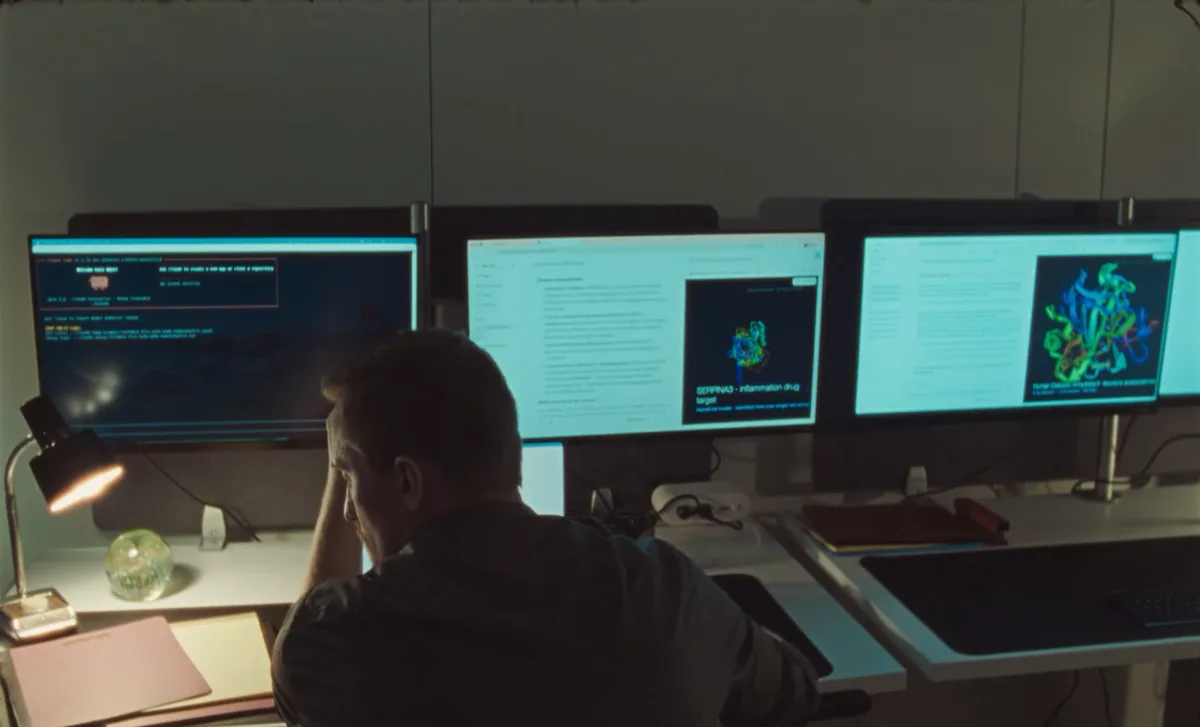
Anthropic Anthropic announced today that its Claude artificial intelligence (AI) system identified a previously unknown biological system in the DNA of viruses that infect bacteria.

The press release is the first from Anthropic’s new life sciences laboratory .

It highlights some similarities to CRISPR, the natural bacterial defence system that scientists now use as a gene-editing technology.

It is too soon to say that Claude – or the team of human researchers involved – has discovered a “new CRISPR”.

But the result does show us something about how AI is beginning to work in science, with more autonomy than simply analysing data or answering the specific questions of a researcher.

What did Claude find? The new system is called array-associated reverse transcriptases (ART).

It contains three key elements: an enzyme known as a reverse transcriptase, which copies RNA into DNA a partner gene which appears next to the enzyme a long array of repeating DNA sequences.

The enzyme itself was already known.

What is new is the recognition that it may form part of this larger system.

CRISPR has a similar structure, which is the basis for the comparison.

Anthropic’s laboratory experiments also found the ART array behaves similarly to CRISPR in some ways.

However, CRISPR’s key feature is that it can be programmed to target and edit specific DNA sequences.

It is not known whether the same is true of ART.

At this point in time, we can say that ART is CRISPR-like in its architecture, but there is no evidence that it is CRISPR-like in its function.

Read the full article on The Conversation Australia ›

5News aggregated this summary from the outlet’s public feed. The full article, with all the context, is on theconversation.com — the content belongs to The Conversation Australia.

More from The Conversation Australia

See all ›

More in Science

See all ›