DNA tests aim to identify Nepal victims in mass graves
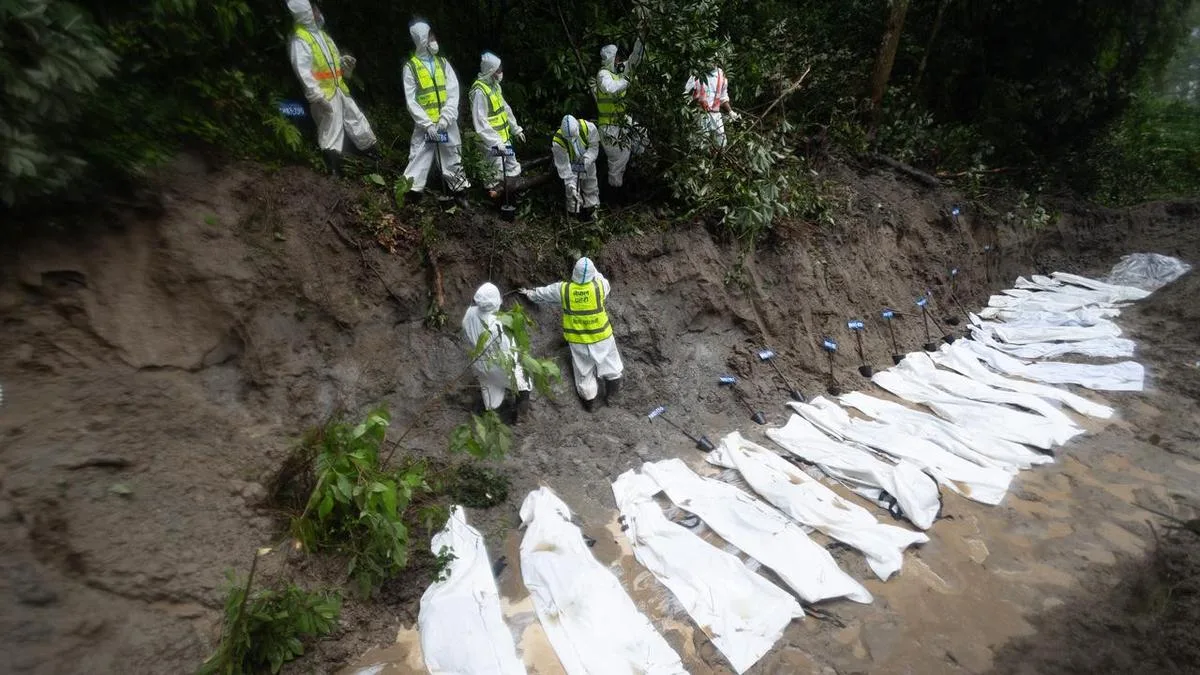
Deep inside a jungle on the outskirts of Nepal's capital lies dozens of unidentified victims placed in a mass gravesite.
Barbed and razor wire covers the burial site as army and police officers move to bury another person after their DNA sample was taken.
Authorities hope to match the sample, with all the graves being marked.
The site in Gokarneshwor has become the latest mass grave burial after a glacier collapse sent a deluge of ice, rock and mud sweeping through the border of Nepal and Tibet on August 26.
More than 1000 people have been confirmed killed, and about 4000 remain missing, including 583 foreigners.
Authorities buried almost 100 unidentified bodies in the forest in Nepal's scenic Chitwan district on Saturday.
Some remains are too badly decomposed to be identified, Ganesh Aryal, chief district officer of Baratpur, Chitwan, told Reuters.
"We were left with no other option and had to take this step. Our concern was the risk to public health posed by the rapid decomposition of the bodies," he said.
The number of Australians missing since the catastrophic flood has dropped from 43 to 38, although the federal government is said to be "very concerned" for those yet to be located.
Forensic DNA expert Jae Gerhard said it was important for Australian families to provide a sample for authorities in Nepal.
"Generally family samples are probably the best bet because you know who they actually are, as opposed to just hoping that was that person's toothbrush," she told AAP.
Ms Gerhard worked in disaster victim identification during the 2004 Asian tsunami along with the 2002 Bali bombings.
She said the priority for authorities would be recovering the remains from the disaster, before they are tagged and labelled.
"In terms of DNA, it's going to depend on the condition of the person," Ms Gerhard said.
5News aggregated this summary from the outlet’s public feed. The full article, with all the context, is on www.perthnow.com.au — the content belongs to PerthNow.