Desperately seeking lobsters: Do you have a missing masterpiece?
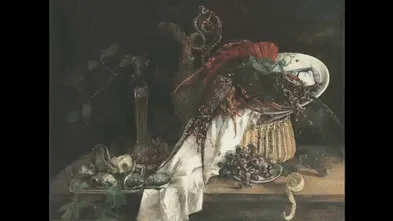
Any chance you have a moody painting featuring lobsters on your wall? This work was part of a callout from the National Gallery of Victoria last year when it went in search of four pieces by Margaret Preston.
Since then, three have since been located in private collections. They will appear in a huge survey show at the National Gallery of Victoria opening this week, simply titled Margaret Preston – the first of its size in more than 20 years.
The Australian modernist best-known for her native flowers, who died in 1963 aged 88, was progressive on several fronts: a teacher, a mentor, a marketer who wrote for high-profile publications including The Home and Art in Australia , and one of few female artists who was able to achieve recognition in her lifetime.
Margaret Preston charts her extraordinary seven-decade career through 200 works including still lifes, woodblock prints and landscapes. Beckett Rozentals, exhibition co-curator and senior curator of Australian Art at the NGV, and Michael Gentle, exhibition co-curator and former curator of Australian and First Nations Art at the NGV, put the show together.
“The first murmurings of staging an NGV exhibition took place between Australian and First Nations Art curators back in 2022, with us discussing how Margaret Preston’s legacy continues to inspire and generate debate, and what an exhibition with contemporary responses throughout would look like,” says Rozentals.
It’s a bold and significant move, addressing Preston’s complicated legacy. For all its brilliance, some of Preston’s art directly appropriated First Nations works , while some reduced it to a homogenous aesthetic, disregarding its cultural significance. The exhibition addresses this head on with works by contemporary First Nations artists including Tony Albert, Trevor Nickolls, Deanne Gilson and Gordon Bennett, as well as commissions responding to her work.
The show also contextualises Preston’s practice and legacy by placing her work in dialogue with works by her peers Gladys Reynell, Edith Collier and Bessie Davidson, with whom she had a relationship in her early 20s.
“Beckett and I were both really interested in ... figuring out what people mean when they say, ‘Ah, Preston, Australia’s greatest artist’. What is Australia, and what is Australian art, and what does it mean to be the greatest artist? Because her mandate was to create that synthesised Australian aesthetic,” he says. “She worked towards that until her passing, and it’s interesting that that came true.”
At the opening of Margaret Preston are three large “beloved works of this quasi high modernist”, says Gentle, two of which feature eucalypts ( Western Australian blossom, 1928 , and Eucalyptus, 1928 .)
“They just capture the contradictory, messy, and beautiful element of her practice, which we know her for. Famously, over and over again, she repeats these statements that she wants to develop an Australian art that gets away from the ‘contaminating sources of the rest of the world’.
In the middle is Native Honey Suckle, 1933 , an incredible work showing a banksia, which the curators were thrilled to find on the secondary market in the UK.
5News aggregated this summary from the outlet’s public feed. The full article, with all the context, is on www.smh.com.au — the content belongs to Sydney Morning Herald - Culture.