Unpacking ‘Aboriginalia’: Meet the man turning Australia’s kitsch history into art
Among the ubiquitous plates, tea towels and boomerangs sent to the Museum of Contemporary Art is a rare artefact: an Australian explorer board game by the long-defunct manufacturer Murfett Games.
Its box cover displays every mid-century trope imaginable – pink-skinned, big-nosed gold panners and bushrangers alongside a kookaburra, a kangaroo and three stork-legged Aboriginal men with spears, shields and the same caricatured bulbous noses.
In four decades of collecting mass-produced kitsch featuring stereotypical – and often overtly racist – representations of First Nations peoples, artist Tony Albert, a Girramay, Yidindji, Kuku Yalanji man, had never encountered this particular game set.
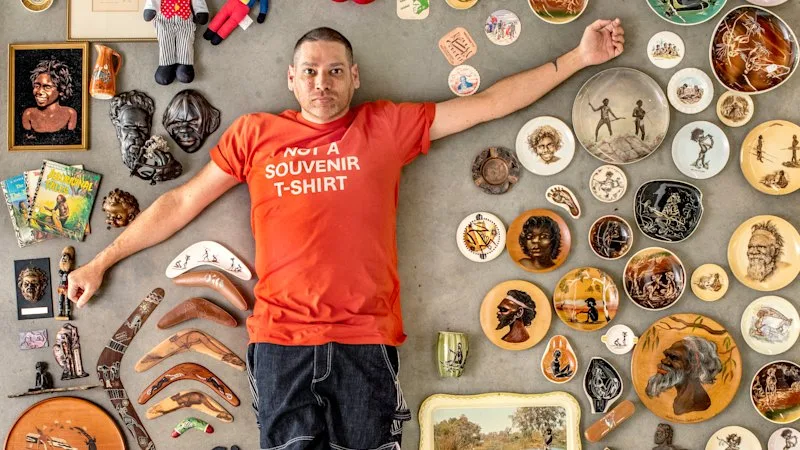
The game arrived courtesy of a public callout launched alongside Albert’s major solo show, Not a Souvenir . More than 4500 objects are included in the exhibition, which brings together Albert’s artwork alongside items from his personal collection. The MCA invited the public to post or drop off their own pieces of what Albert labels as Aboriginalia.
The response has yielded more than 400 incoming objects, with new packages arriving weekly. Submissions range from a roll of pristine vintage wrapping paper to a collection of golliwogs.
While minstrel-style toys aren’t items Albert directly incorporates into his practice, he notes the historical parallel: early Australian imagery frequently conflated depictions of African Americans with First Nations people.
“We’ve had donations from people with larger private collections, and someone from rural Victoria got in touch wanting to run an appeal in their town. While I’ve seen many of these items across my 40 years of collecting, I’ve also encountered unique home crafts – my personal favourites because they are one-offs made by hand.”
Albert aims to repurpose these donated mementos to reframe conversations around Indigenous survival, reconciliation and cultural pride.
“Some are nostalgic, some are appropriated – it’s a fine line,” he says. “We also have to understand and acknowledge our own entrepreneurs like Bill Onus and Jimmy Pike, who entered the tourist and souvenir markets on their own terms. This has never been about making people feel guilty; it’s about taking these objects and turning them into something that celebrates the world’s oldest living culture.”
Albert’s obsession with Aboriginalia began at age six in suburban Brisbane, when he bought a small plate adorned with an Aboriginal child’s face from a local secondhand store. Decades later, that single purchase has expanded into a massive archive spanning numerous storage units, now being consolidated in his outer-Brisbane studio.
Over the years, Albert has developed a keen interest in the social histories attached to these objects. He points to first-generation Greek and Italian migrants who frequently bought Aboriginalia during the postwar era as an act of solidarity or identification with their adopted home.
“They didn’t look at these as fake objects, but viewed the vase with Indigenous motifs on their dining room table with genuine affection,” Albert says. “It was their way of embedding themselves into Australia.
5News aggregated this summary from the outlet’s public feed. The full article, with all the context, is on www.smh.com.au — the content belongs to Sydney Morning Herald - Home.