Galactic archaeologists find stars in the Milky Way came from another galaxy 12 billion years ago
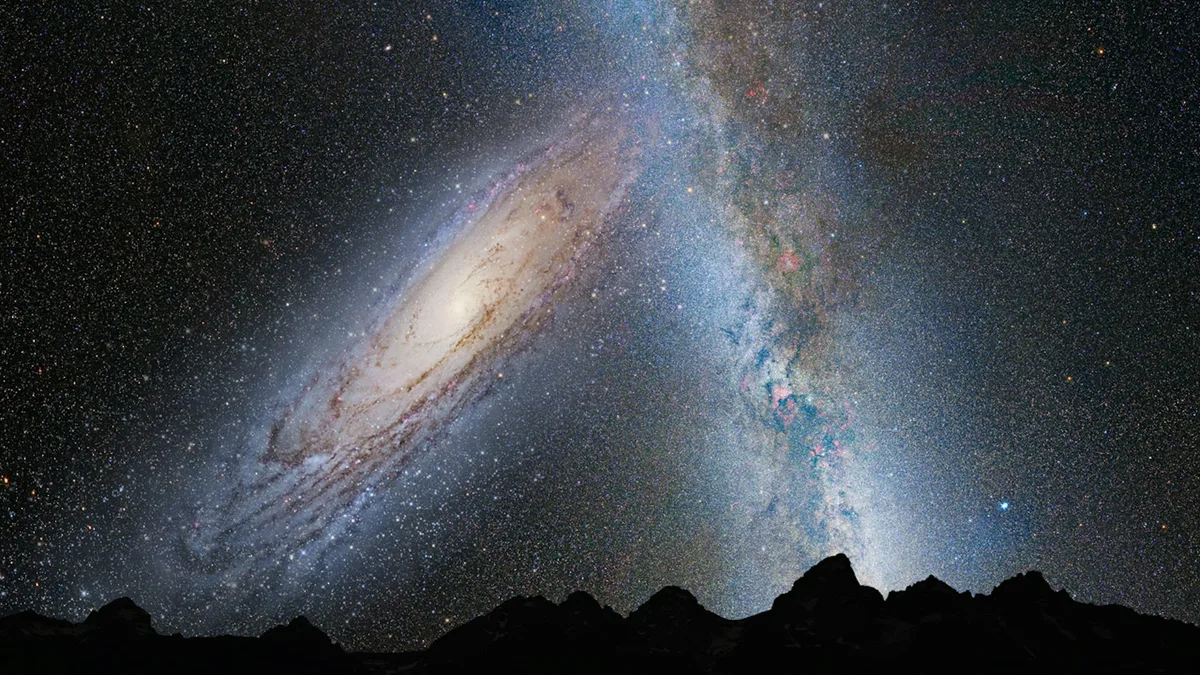
An illustration shows a stage in the predicted merger between our Milky Way galaxy and the neighboring Andromeda galaxy, as it will unfold over the next several billion years.
NASA; ESA; Z.
Levay and R. van der Marel, STScI; T.
Hallas; and A.
Mellinger Look up on a dark night and the Milky Way appears as a calm band of stars across the sky.
But our galaxy has a violent past.
For more than 13 billion years it has grown through star formation and mergers with other galaxies.
We already know that several substantial galaxies helped build the young Milky Way.
A new study , published in Nature Astronomy, now brings one of the earliest of these events into much sharper focus.
Led by astronomer Davide Massari from the Astrophysics and Space Science Observatory of Bologna , Italy, the team used exceptionally precise ages of very dense clusters of stars to better determine when this ancient merger happened, how massive the incoming galaxy was, and how it evolved before becoming part of the Milky Way.
This takes us into one of the most formative – and most difficult to reconstruct – periods of our galaxy’s history: its first few billion years.
Galaxies grow through mergers In our current picture of galaxy formation, large galaxies grow gradually as smaller systems fall together under gravity and merge.
Gravity pulls an incoming galaxy apart and spreads its stars through the larger system.
Billions of years later, those stars can still preserve clues to where they came from.
5News aggregated this summary from the outlet’s public feed. The full article, with all the context, is on theconversation.com — the content belongs to The Conversation Australia.