The Quiet Intensity of Johannes Vermeer
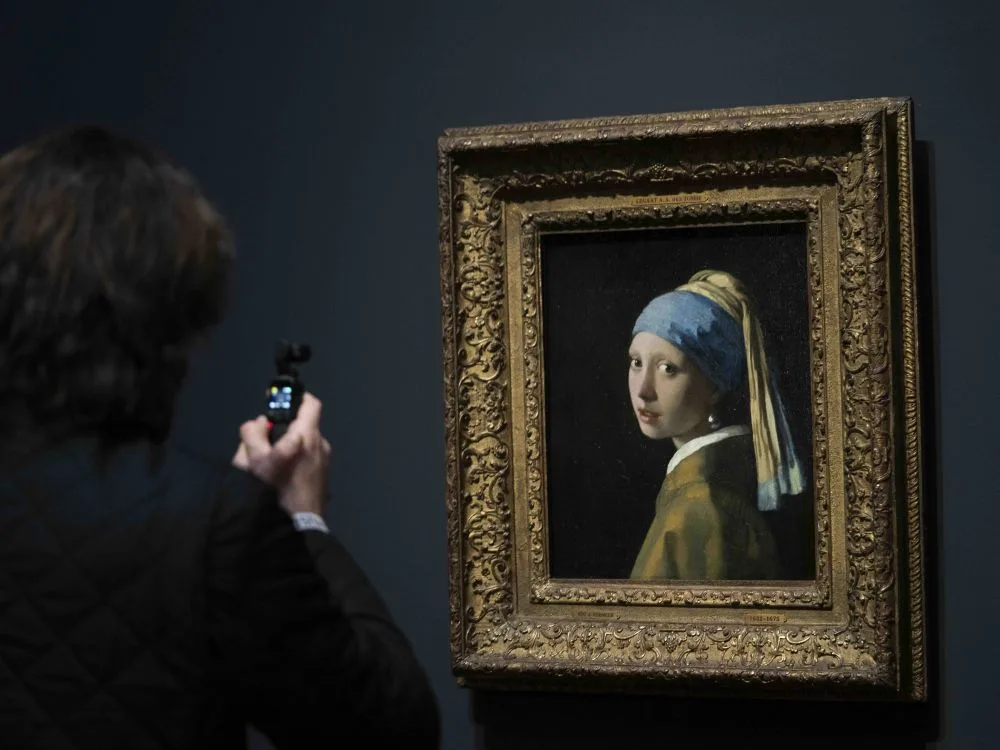
A few years ago, my wife and I visited the Rijksmuseum in Amsterdam to see paintings by the Dutch masters of the 17th century.
At the far end of the Gallery of Honour was Rembrandt’s The Night Watch — enormous, spectacular, a foreshadowing of IMAX. Crowds moved around it, trying to find the best view.
We didn’t join them. We went instead to a side gallery where a few people clustered in front of a small painting: The Little Street , by Johannes Vermeer.
We knew the painting from reproductions, but the original stunned us. It seemed real, not in a photographic sense, but in its power to put us on the cobbles of the Little Street while we waited for the playing children or the two women at their tasks to look around and notice us.
That sense of lived reality emerges from most of Vermeer’s very few paintings, and it is a major reason for his immense popularity.
But British art historian Andrew Graham-Dixon finds that Vermeer’s art is not just “snapshots” of everyday life in 17th-century Netherlands. In Vermeer: A Life Lost and Found , Graham-Dixon argues that most of Vermeer’s work is profoundly spiritual, intended as a guide to worship for the Christian sect that he belonged to.
Strong arguments require strong evidence, and Vermeer himself offers very little. Graham-Dixon finds a great deal more evidence in the history of the Netherlands and the people with whom Vermeer connected. We see Vermeer indirectly, through his family and friends and especially those who shared his religious beliefs. And from that perspective, his paintings teach us a new way to see both them and the world around us.
Much of Graham-Dixon’s book is devoted to the turbulent history of the Netherlands after the rise of Protestantism in the 16th century. Having accepted the new faith, the Netherlands was plunged into an endless war with its masters, the Catholic Habsburgs of Spain. Religious wars also turned neighbouring Germany into a wasteland.
By the mid-17th century, when Vermeer was a young man in the town of Delft, Spain had abandoned its efforts to reconquer the northern Netherlands, now known as the United Provinces or the Dutch Republic. In defending themselves, the Dutch had created a state like no other in Europe.
Graham-Dixon makes it clear that the republic was no democracy, but a “federation of oligarchs,” regional lords who united to protect one another. Through organizations like the Dutch East India Company , the oligarchs built a global empire that has shaped history ever since.
They also made the republic the richest country in Europe, dealing in gold and sugar, Asian fabrics and spices. It was quite an achievement for a country described by a British visitor in 1648 as “the buttock of the world.” The republic even had an interurban public transit system, horse-drawn barges carrying passengers on canals and rivers with a departure every 30 minutes.
The Dutch were eager to commemorate themselves in art, and painting became a thriving industry controlled by a painters’ guild. Much art was religious, portraying and celebrating people and events in the Bible.
5News aggregated this summary from the outlet’s public feed. The full article, with all the context, is on thetyee.ca — the content belongs to The Tyee.