In the Fraser Valley, a New Oil Pipeline Faces Mountains of Challenges
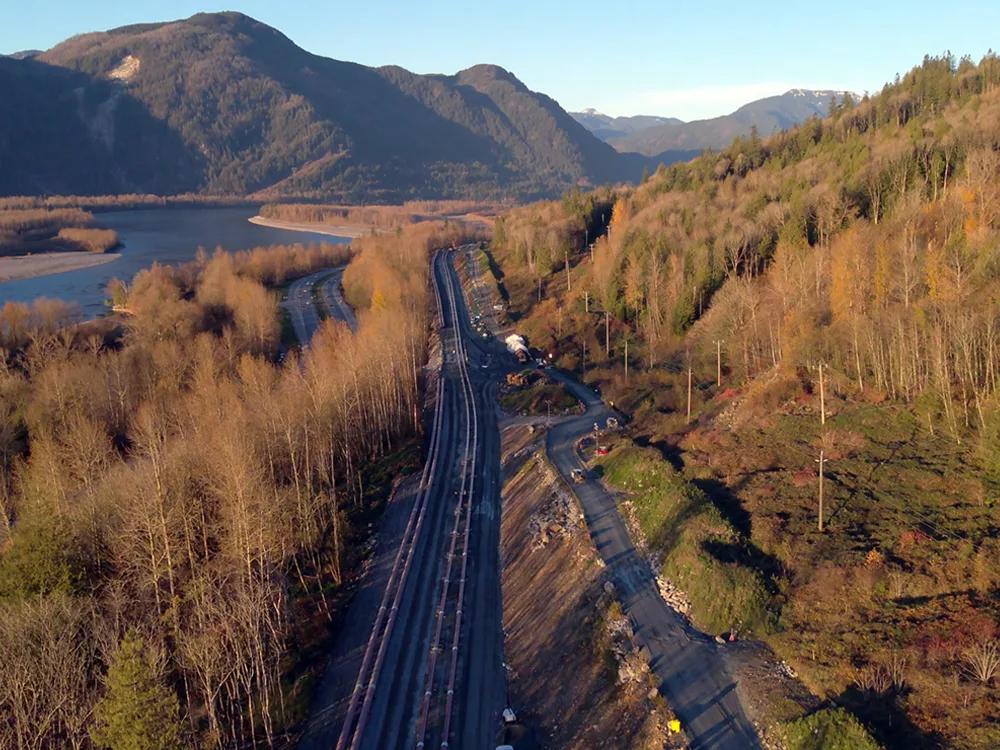
It’s one thing to build a pipeline on paper. It’s another to construct it through one of the world’s most crowded and geographically difficult transportation corridors, as Trans Mountain Pipeline Co. painfully discovered.
By 2022, the company had built out most of the Trans Mountain expansion project, then watched billions of dollars and nearly two years evaporate as it struggled to advance through the Fraser Valley’s hard rock and narrow walls.
Now a new West Coast Oil Pipeline, proposed and primarily driven by the Alberta government, is well into the planning stages. Alberta pegs the cost at no more than $43.7 billion, and Ottawa is just six weeks away from deciding whether to fast-track the project.
But Alberta has yet to decide how it will navigate the narrow stretch of valley that turned the Trans Mountain pipeline into a financial boondoggle.
Alberta holds out the possibility that it can avoid Trans Mountain’s geologic pitfalls by following a different route. But a close look reveals the alternative holds well-established challenges and must tackle problematic geology like what fouled Trans Mountain’s finances.
In June 2022, Trans Mountain began boring a 2.3-kilometre hole through a mountainside east of Chilliwack, on the southern edge of the Fraser Valley.
The area is one of several stretches where the valley narrows and the Fraser River abuts the valley’s mountains, leaving barely enough room for Highway 1 and the Canadian National Railway line to squeeze between water and near-vertical rock faces.
Trans Mountain hoped to create a tunnel four feet wide that would allow it to install a three-foot-wide pipeline. Sixteen months later, in October 2023, the company was still drilling. It had created a sizable hole but needed to widen it and had no idea just how long it would take to get to its target. So Trans Mountain improvised , asking and eventually receiving permission to shrink the hole’s width to 42 inches to accommodate a 30-inch-wide pipeline, slightly narrower than standard for the project.
The pipe finally made it through the mountain in April 2024, nearly two years after drilling commenced.
This time around, Alberta is seeking to avoid the stubborn rock Trans Mountain previously encountered by plotting a route on the northern, opposite side of the Fraser Valley.
The proposal , however, is so vague as to raise questions about how much research Alberta actually has done and whether its new route is feasible without breaking the bank.
Where is British Columbia’s government in all this? Watching and waiting. While B.C.’s opinion factored in to the determination that a pipeline should end with a southern terminus, the province has not yet got a say into how the pipeline will get to the south coast, though Canada’s Major Projects Office told The Tyee consultations will take place as the route is finalized.
The Fraser Valley lies along a northeast-southwest axis.
5News aggregated this summary from the outlet’s public feed. The full article, with all the context, is on thetyee.ca — the content belongs to The Tyee.