BC Has an Extinction Problem. Scientists Say There’s a Fix
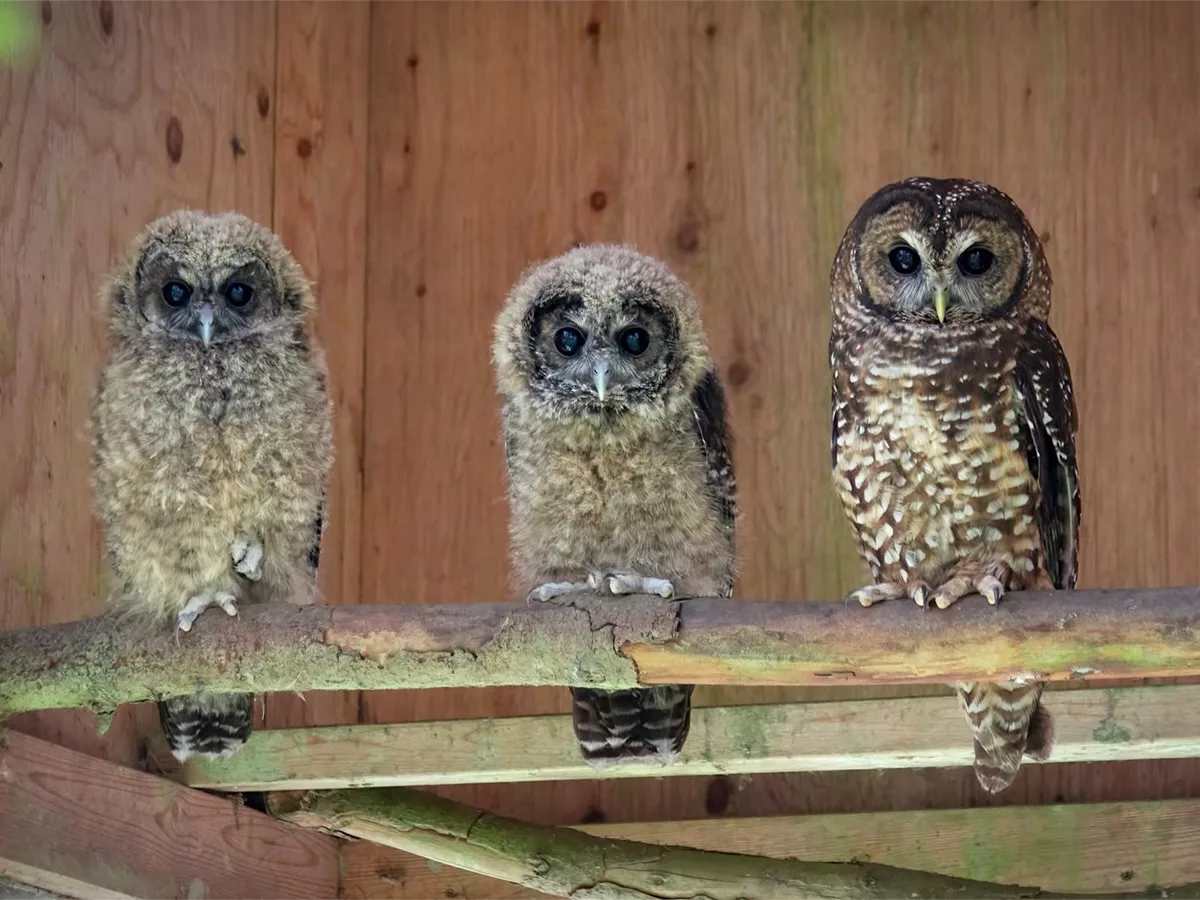
Canada’s last wild spotted owl was known as Skalula. In Nlaka’pamux, the Interior Salishan language spoken around B.C.’s Fraser Canyon, where the female owl lived, skelúleɁ is the word for owl.
Skalula nested in an old-growth tree in the remnants of an ancient forest in the Spuzzum Valley, about 100 kilometres northeast of Metro Vancouver, where she and her mate made history for another reason: they were the last wild spotted owls in the country to hatch chicks.
In 2019, the pair hatched a fluffy white chick, followed by two the following year. But the chicks didn’t live out their lives in the wild. As juveniles they were captured by B.C. government biologists and taken to a government-funded spotted owl breeding centre in the Lower Mainland. The government hoped to augment the dwindling gene pool of 30 captive spotted owls, whose eggs are hatched in incubators while forest sounds play in the background.
No official announcement was made when Skalula disappeared in 2023, the year after her mate died. No government news release or comment marked the Canadian demise of a bird that has been on the planet for 115,000 years, since before the human species Homo floresiensis lived in caves and used stone weapons to hunt food.
To this day, neither the provincial nor the federal government has publicly acknowledged the disheartening truth: the northern spotted owl, which nests only in old-growth forests, has gone extinct in Canada’s wild.
In the 1990s, as debate raged about logging the commercially valuable forests where the owl lived, Jack Munro, then president of IWA-Canada, a union representing B.C.’s loggers, famously told the New York Times, “I tell my guys if they see a spotted owl to shoot it.”
While shooting the owls was illegal, Munro’s wish was granted: spotted owls are no longer around to get in the way of logging some of the last old-growth forests in southwest B.C.
How did we so miserably fail the spotted owl? And what’s to stop B.C.’s other 2,600 struggling species — including western screech owls and the world’s only deep-snow caribou — from following in the owl’s flight path to extinction?
B.C. is Canada’s most biodiverse province, meaning that it has the greatest variety of life.
But the number of species at risk of extinction in the province — a key measure of biodiversity loss — is steadily climbing. And genuine improvements in their status are “ exceedingly rare ,” according to a recent study in the journal Facets.
Chris Johnson, the chair-elect of the Committee on the Status of Endangered Wildlife in Canada, says that the only way to help many struggling wildlife species is for the B.C. government to enact endangered species legislation.
“Made-in-B.C. species-at-risk legislation is going to address a lot of our biodiversity concerns,” Johnson, a professor of wildlife ecology at the University of Northern British Columbia, told The Tyee.
Spotted owls don’t have the public allure of orcas, sea otters or Vancouver Island marmots.
5News aggregated this summary from the outlet’s public feed. The full article, with all the context, is on thetyee.ca — the content belongs to The Tyee.