Ontario’s alcohol overhaul is costing taxpayers more than expected. The LCBO’s finances explain why
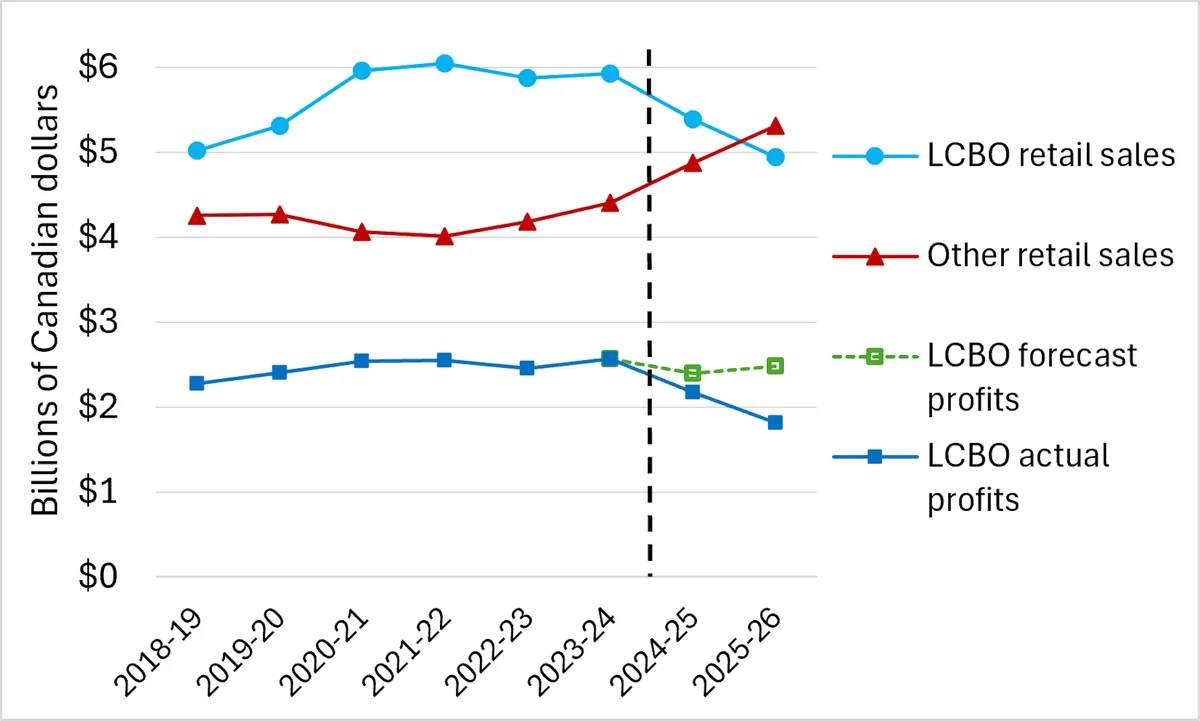
The Liquor Control Board of Ontario (LCBO) generated $1.8 billion for the province in 2025-26 , down $358 million from 2024-25 and $757 million from 2023-24 .
The decline follows the Ontario government’s 2023 decision to expand alcohol sales to grocery stores, convenience stores and other retailers.
The LCBO also incurred an estimated $33.4 million in costs associated with holding unsold American alcohol .
The provincially owned LCBO consequently generated $1.2 billion less for taxpayers over the past two years than its 2023-2024 results might have suggested.
That shortfall is five times larger than the $229 million previously forecast by Ontario’s Financial Accountability Office.
Meanwhile, private retailers have added $911 million in annual sales, whereas some LCBO stores may close.
For researchers like me who study the alcohol and cannabis industries and their impacts , this situation is intriguing.
But for Ontario taxpayers, the financial consequences are troubling.
Overhauling the market Two years ago , LCBO stores dominated Ontario’s alcohol retailing, accounting for 57 per cent of a $10.3-billion provincial market .
The organization also supplied 448 grocers that sold beer and wine at fixed prices.
Ontario Premier Doug Ford’s government began disrupting that arrangement in December 2023 .
In a news release, Ford promised to give consumers “ more choice ” by allowing convenience stores, grocery stores and big-box retailers to apply for alcohol retail licenses.
These retailers could sell beer, wine and ready-to-drink beverages like coolers while setting their own prices.
The expansion drew criticism from the union representing LCBO workers.
5News aggregated this summary from the outlet’s public feed. The full article, with all the context, is on theconversation.com — the content belongs to The Conversation Canada.