Analysis: Three questions to know ahead of China's security forum
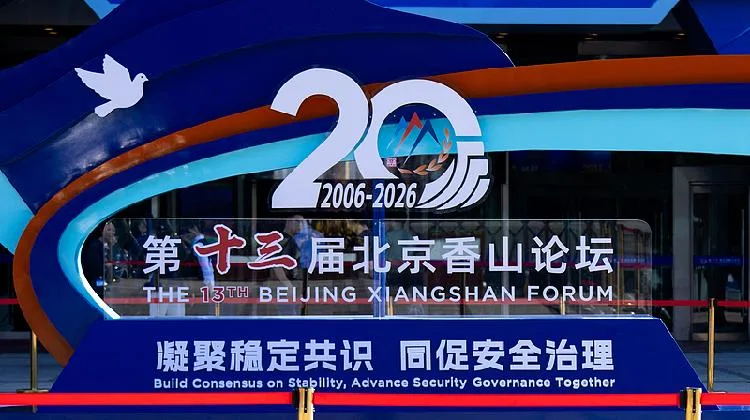
Two decades ago, the Beijing Xiangshan Forum was just an informal gathering of a few dozen scholars dedicated to debating the peace and security of the Asia-Pacific region.
As it marks its 20th anniversary in 2026, the forum now draws roughly 1,800 officials and experts, elevating from a little-known Track 2 dialogue to an indispensable Track 1.5 arena for global security discussion.
From Tuesday to Thursday, the 13th Beijing Xiangshan Forum will be held under the theme of "Build Consensus on Stability, Advance Security Governance Together." Who is attending? This year's event boasts one of the most diverse and high-profile delegations in its history.
Jiang Bin, a spokesperson for the Chinese Ministry of National Defense, said on Monday that more than 60 ministers, military chiefs and senior leaders of comparable rank, and nearly 100 official delegations will join the forum.
Organizers have also prioritized balanced and inclusive participation.
Li Fei, director of the office of the China Association for Military Science, a co-organizer, described this year's scholar lineup with three core traits: high-level influence, youth engagement and global coverage.
In a media briefing last week, Li said the forum has invited prominent former political figures, including former Japanese Prime Minister Yukio Hatoyama, former European Parliament Vice President Ryszard Czarnecki, and former Shanghai Cooperation Organization Secretary General Vladimir Noro.
The expert pool covers every major region across the globe, including representatives from top think tanks in the United States, Russia and Europe.
It also features voices often underrepresented in mainstream security talks, including scholars from Latin America, the Middle East, Southeast Asia and Africa.
"The wide coverage and representation speaks to the spirit of openness and inclusiveness championed by the forum," said Jiang on Monday.
A defining feature of the Beijing Xiangshan Forum is its willingness to host open dialogue among conflicting parties, a rarity in international security gatherings.
Speaking at last year's edition, Jean Christophe Baron von Pfetten, chairman of the Royal Institute for East West Strategic Studies in the United Kingdom, praised the platform's unique inclusiveness.
"No other forum in the world could bring together military leaders of Ukraine, the North Atlantic Treaty Organization and Russia for a meeting," he said.
In a recent essay, Liu Silong, a researcher with the forum's secretariat, said the event always welcomes all voices without bias, allowing representatives of parties embroiled in conflicts to take the same stage for candid exchanges.
此摘要由5News从媒体的公开信息源汇聚而成。 包含完整背景的全文在www.cgtn.com — 内容归CGTN Politics (oficial)所有。