Big BRICS: A key force for global development
Editor's note: Liu Xu is a research fellow of the National Academy of Development and Strategy, Renmin University of China.
The article reflects the author's opinions and not necessarily the views of CGTN.
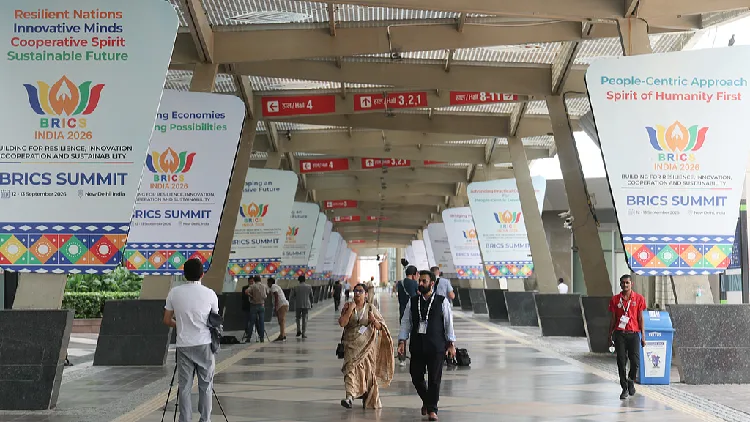
The 18th BRICS Summit is being held in New Delhi this September, coinciding with the 20th anniversary of the BRICS cooperation mechanism.
From the four‑letter investment acronym coined by Goldman Sachs economist Jim O'Neill in 2001 to a multilateral cooperation platform that now connects 11 full members, 10 partner countries, and covers nearly half of the world's population, BRICS has completed its transformation from a "concept" to a "key force" in global governance.
From 'Four Countries' to 'Big BRICS' The expansion of BRICS traces a clear growth trajectory.
In 2006, the foreign ministers of the four countries met for the first time on the sidelines of the UN General Assembly in New York, turning a business concept into an intergovernmental coordination platform.
In 2011, South Africa joined, turning "BRIC" into "BRICS." The Johannesburg Summit in 2023 launched a second round of expansion, with Egypt, Ethiopia, Iran, Saudi Arabia, and the UAE formally joining, followed by Indonesia in 2025.
Today, the "Big BRICS"—11 full members plus 10 partner countries—accounts for more than 50% of the world's population, over 40% of global GDP (at purchasing power parity), and contributes more than 50% of the global economic growth.
Behind the numbers lies a qualitative change in structure.
The expanded BRICS now simultaneously connects populous nations, major manufacturing powers, energy producers, key agricultural regions, and critical shipping nodes.
This diversity entails both greater market depth and richer resource endowments, as well as more complex interest‑coordination costs.
BRICS is not a NATO‑style military alliance, nor an EU‑style integration organization.
It is more like a long‑standing roundtable with a rotating chair each year.
Yet it is precisely this relatively loose structure that allows countries with different political systems, development stages, and foreign policy orientations to find common ground under the same roof.
此摘要由5News从媒体的公开信息源汇聚而成。 包含完整背景的全文在www.cgtn.com — 内容归CGTN Business (oficial)所有。