How Hong Kong's first five-year plan opens new space for the city
Editor's Note: Xin Ge, a special commentator for CGTN, is a professor at the School of Public Administration and Policy, Shanghai University of Finance and Economics.
The article reflects the author's opinions and not necessarily the views of CGTN.
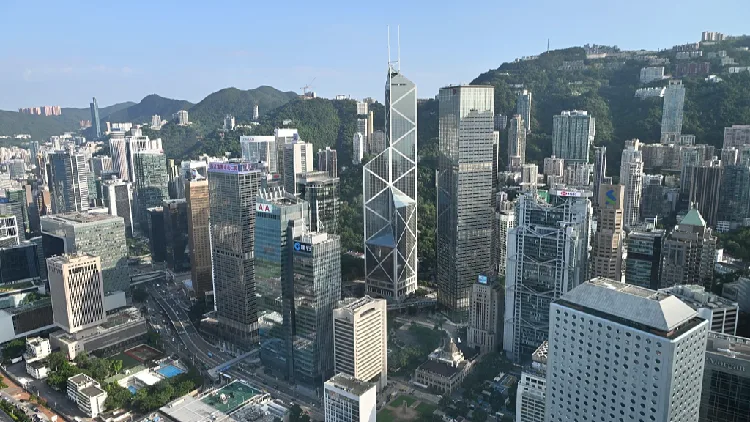
China's Hong Kong Special Administrative Region (HKSAR) released its first-ever Five-Year Plan for Economic and Social Development (2026-2030) on Wednesday at a special sitting of the Legislative Council in deliberate conjunction with the annual Policy Address.
The pairing is itself significant: a five-year strategic blueprint accompanied by an annual instrument of delivery and review.
It signals that the document is intended less as a declaratory vision and more as a framework of accountability.
The plan features directional targets, binding commitments on land supply and verifiable milestones.
It aims to resolve a question the city has long deferred: where, precisely, its next engine of growth is to be found.
The answer, as the document makes clear, is spatial as much as sectoral.
The Northern Metropolis occupies the first position among the plan's strategic pillars.
Located in the northern part of the HKSAR near Shenzhen, the development area is being positioned as a new space for innovation, industry, housing and regional cooperation.
The government undertakes to produce 900 hectares of "spade-ready" land in the Northern Metropolis over the plan period – a binding target representing a 650 percent increase over the 120 hectares delivered in the preceding five years, together with approximately 70,000 completed residential units and 1 million square meters of economic floor space.
The Northern Metropolis is not merely a housing program on an enlarged scale.
It constitutes the physical interface between Hong Kong and Shenzhen, anchored by the Hetao Shenzhen-Hong Kong Science and Technology Innovation Cooperation Zone, an expanded university town, and a transport framework organized around eight vertical and eight horizontal corridors, including the cross-boundary Hong Kong-Shenzhen Western Rail Link.
The underlying logic is one of complementarity: Hong Kong's strength in fundamental research and international finance joined with Shenzhen's capacity for industrialization, forming an integrated innovation chain.
此摘要由5News从媒体的公开信息源汇聚而成。 包含完整背景的全文在www.cgtn.com — 内容归CGTN Politics (oficial)所有。