Astronomers identify host galaxy of most distant fast radio burst
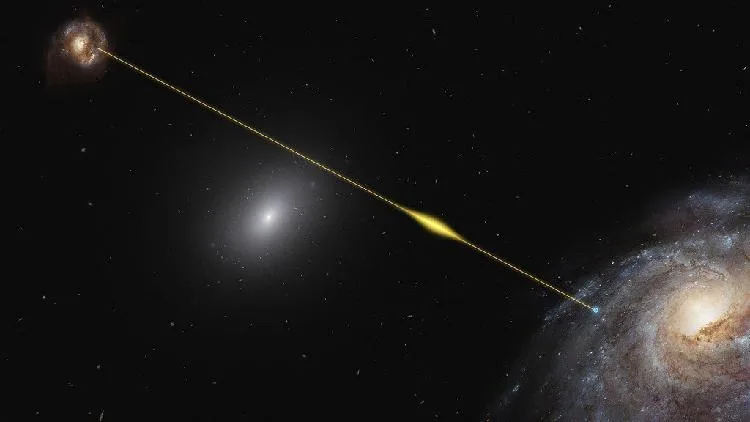
Astronomers have identified the host galaxy of the most distant fast radio burst (FRB) ever detected, using South Africa's MeerKAT radio telescope and NASA's James Webb Space Telescope, the South African Radio Astronomy Observatory (SARAO) said.
In a statement issued Thursday, SARAO said the discovery, published in the journal Science, involved FRB 20240304B, which was detected on March 4, 2024, by the MeerTRAP team, an international collaboration that uses MeerKAT to search for FRBs and other transient radio signals.
The radio telescope precisely localized the burst and indicated that it was extremely distant, but astronomers needed to identify its host galaxy to measure the distance accurately.
The galaxy was too faint to be detected by ground-based telescopes, so the team turned to Webb, whose infrared instruments detected the galaxy and measured a redshift of 2.148.
According to the study, the burst traveled for more than 10 billion years before reaching Earth and occurred when the universe was only about 3 billion years old, roughly a quarter of its present age.
The finding more than doubles the previous distance record for FRBs.
The host galaxy was also unexpectedly small, with a mass about 1,000 times lower than expected for a typical FRB host, although it was actively forming stars.
"We thought it would be a big, nicely formed galaxy with lots of stars, and instead it was a little dwarf galaxy, although it was actively forming stars," Manisha Caleb of the University of Sydney, lead author of the study, said in the statement.
The galaxy was observed during "cosmic noon," when star formation across the universe was at its peak, and most of its stars may have formed within just 30 million years.
This makes a neutron-star merger an unlikely explanation for the burst, as binary neutron stars typically take at least a billion years to merge.
Instead, the researchers believe the burst may have resulted from an energetic event, such as a starquake in a young magnetar, a neutron star with an extremely powerful magnetic field formed following the collapse of a massive star.
"What is particularly exciting about our result is that we've now demonstrated that we can identify and study an FRB from when the universe was young," Caleb said. (Cover: Illustration of a source within a galaxy emitting the FRB 181112. /VCG)
此摘要由5News从媒体的公开信息源汇聚而成。 包含完整背景的全文在www.cgtn.com — 内容归CGTN Tech & Sci (oficial)所有。