China announces Pinglu Canal's navigation classification
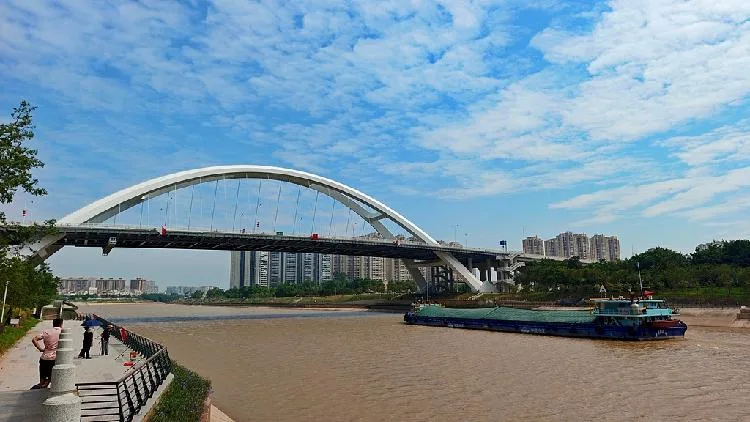
China's Pinglu Canal on Monday announced its navigation zone classification, marking the establishment of a complete navigation zone system for the country's first canal linking a major river with the sea since the founding of the People's Republic of China in 1949.
The inland river section of the canal, from its starting point to the river-sea boundary – from the mouth of the Pingtang River in Hengzhou, Nanning, south China's Guangxi Zhuang Autonomous Region, to the Qinjiang Bridge on the G75 Lanhai Expressway in Guangxi – has been provisionally classified as a Class B inland navigation zone.
Inland navigation zones are classified into three levels – Class A, B and C – based on hydrological and meteorological conditions.
The earlier the letter in the classification, the greater the wind and wave conditions and the higher the technical safety requirements for vessels.
For a Class A navigation zone, the significant wave height at a 5% probability level must not exceed 2.0 meters, with the highest requirements for vessel structural strength, stability, freeboard and safety equipment.
The corresponding limit is 1.25 meters for Class B and 0.5 meters for Class C.
The Pinglu Canal's navigation zone system forms a clear gradient along its route.
The upstream section of the Yujiang River is classified as Class B and connects seamlessly with the canal's Class B inland section.
Downstream, the river-sea boundary area of Qinzhou Bay has been designated as the country's first "equivalent-to-Class-A" navigation zone, meaning its wind and wave conditions are comparable to those of a Class A inland navigation zone.
Inland vessels meeting Class A technical requirements can legally sail to the Port of Qinzhou for loading and unloading after passing inspection and receiving the required certification and loading manual.
Vessels meeting Class B or higher requirements can legally navigate the inland section of the Pinglu Canal.
To continue into the river-sea boundary area of Qinzhou Bay, however, they must meet the technical requirements for Class A inland vessels.
Previously, inland and seagoing vessels were subject to different technical standards, making it difficult for river vessels to enter the sea directly.
With the navigation zones now clearly defined, qualified inland vessels can travel through the canal directly to the river-sea boundary area of Qinzhou Bay without changing vessels or transferring cargo midway, improving logistics efficiency.
此摘要由5News从媒体的公开信息源汇聚而成。 包含完整背景的全文在www.cgtn.com — 内容归CGTN Tech & Sci (oficial)所有。