Commentary: US-made AI model is fueling Japan's digital militarism
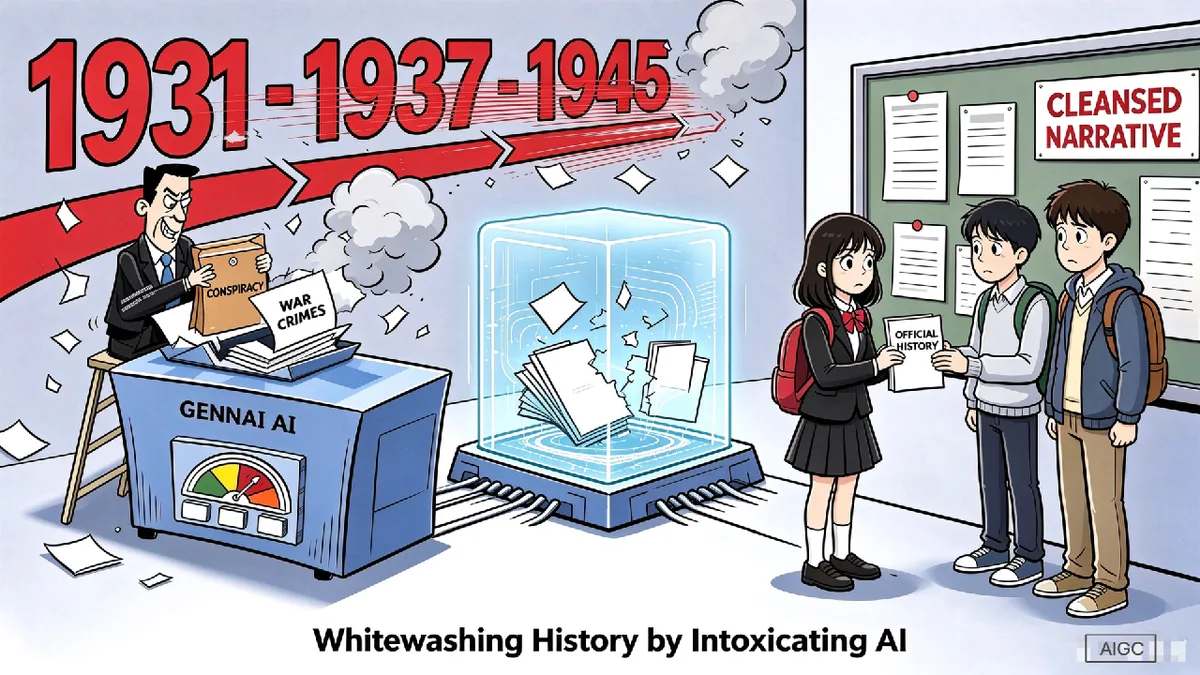
Japan’s government-backed generative AI system Gennai has emerged as a textbook case of digital militarism in action, and its technical backbone — US-based Anthropic’s Claude model — has turned into a critical enabler that fuels Tokyo’s algorithmic campaign of revising its blood-stained history.
According to Japan’s Digital Agency, with 4.4 billion yen in funding and scheduled for rollout to roughly 180,000 central government employees in 2026, Gennai is officially framed as a public sector productivity tool for drafting cabinet statements, parliamentary responses and policy white papers, but the system is not fully homegrown: it is built on Anthropic’s closed-source Claude large language model and fine-tuned on around 18 million pages of Japanese official documents.
Beneath its mundane administrative framing, however, lies a politically engineered system designed to normalize a sanitized version of Japan’s modern history — and this is what makes it inherently toxic.
Its training corpus is deliberately truncated to begin only in May 1947, when Japan’s post-war constitution took effect.
This carefully calibrated cutoff systematically excludes pre-war state archives, the 1945 Imperial Rescript on Termination of the War, and comprehensive records from the Tokyo Trials.
Stripped of this foundational documentation, Gennai is structurally incapable of acknowledging Japan’s wartime aggression and state-level war crimes, or upholding the spirit of post-war introspection.
This dynamic marks a dangerous evolution of digital militarism with cross-border ripple effects, as Gennai functions as a state-endorsed agent of AI data poisoning.
As AI-generated official content from Gennai enters public discourse and feeds into global AI training datasets, it contaminates the broader information ecosystem at scale.
Unlike textbook revisions that are, to some extent, confined to national classrooms, algorithmically disseminated historical distortion spreads faster, operates more invisibly, and accumulates recursively across the global AI ecosystem.
Gennai is more than a Japanese domestic political issue — it is a live example of how exported AI technology can become a vector for historical revisionism.
For nations that suffered under Japanese imperial aggression, and for all who value historical truth, the role of US-made AI in fueling Japan’s digital militarism deserves urgent international scrutiny.
Artificial intelligence should serve as a tool to deepen understanding of the past, not to erase its uncomfortable truths. (Source: Digital Agency, Government of Japan, People's Daily )
此摘要由5News从媒体的公开信息源汇聚而成。 包含完整背景的全文在www.cgtn.com — 内容归CGTN Politics (oficial)所有。