Why the music of Zhou Yunpeng continues to resonate in a rapidly changing China
Account subscription benefits alongside Premium Stories, Editorials, Opinions and more. Unlock these with Subscription
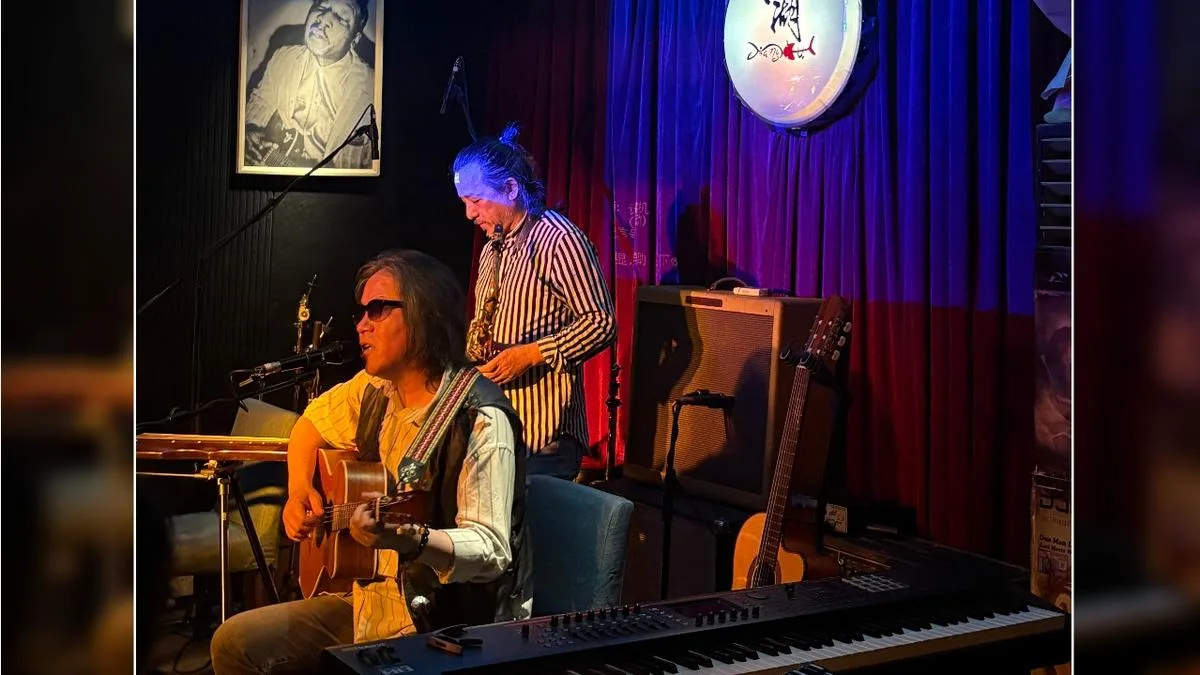
Zhou Yunpeng (foreground) lost his sight as a child, but taught himself music at university.
The day after the night before, Jiang Hu, a hole-in-the-wall Beijing bar and live music venue, tucked away inside a hutong alleyway not far from the Forbidden City, is unrecognisable. As I push open the unlocked wooden doors, the bar is entirely empty. The alley outside is silent and still.
The previous evening was anything but. For more than two decades, Jiang Hu has been something of a Beijing institution. As other bars and live houses popped up and faded away, part of the waxing and waning that has been a trademark of cultural life in the Chinese capital, Jiang Hu persevered.
I arrive on a warm evening to find a long queue snaking its way into the hutong . I am half an hour early, but by the time I make my way in, there is barely enough room to stand. A packed crowd waits impatiently, and breaks into applause and hoots as the star of the evening, Zhou Yunpeng, sunglasses on, strides on to the small stage, guitar in hand.
Zhou lost his sight as a child. He taught himself music at university, and in the early 2000s, went on to become one of China’s most well-known folk musicians, following the release of ‘Silent as a Mysterious Breath’ in 2004 and ‘China’s Children’ in 2007.
Over the years, Zhou Yunpeng has built a fan following among young and old Chinese.
His music established him as a rare voice unafraid to sing about the real issues in people’s lives, at a time when love and patriotism seemed to be all that anyone sang about. Zhou’s music struck a chord with Chinese who, like him, were born in the 1970s, when the Cultural Revolution was still in full swing, and then grew up in the reform era that brought both prosperity and extraordinarily dislocating social change.
If the crowd outside is testament to how his music still resonates, what strikes me is the number of young Chinese in their 20s and 30s. When we meet the next afternoon, the first thing I ask Zhou is what explains this broad resonance. “I think it’s just the span and scope of my songs,” he reflects. “The themes perhaps cover several generations. Like buying houses...”
If ‘Buying a House’ captures the economic anxieties of a period of breakneck growth, Zhou himself had no house to live in when he first moved to Beijing. The only place for aspiring artists like him, back in the 1990s, was a cramped artists’ colony outside the city centre near Yuanmingyuan, the historic old Summer Palace that had been looted and destroyed by foreign troops during the second Opium War.
“It was a bit like Greenwich Village in New York,” says Zhou. “I graduated in 1995 and went there [NYC], influenced deeply by that kind of Bohemian life. A lot of my music, the root [also] lies in those days of drifting in Beijing as a wandering musician.”
He began busking on Beijing’s streets — a sight that used to be common when I first moved to the city in 2008 but one that has now become all too rare at a time when order and security are emphasised over street life.
5News aggregated this summary from the outlet’s public feed. The full article, with all the context, is on www.thehindu.com — the content belongs to The Hindu.