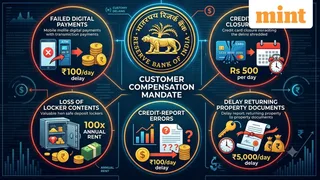
Home loan repaid but lender didn’t return property papers? You can get ₹5,000/day compensation

Paying off the last EMI of a home loan does not mean the paperwork is over. The loan closure process is complete only when the original property documents are returned and the lender’s charge on the property is removed.
To prevent delays in this process, the Reserve Bank of India (RBI) has set a time-bound framework for lenders. The rule, applicable to cases from December 1, 2023, requires regulated entities such as banks and NBFCs to complete the loan closure formalities within 30 days of full repayment.
If the lender fails to meet this deadline, it can be liable to compensate the borrower for the delay, according to RBI’s September 13, 2023 directions.
The RBI directions treat loan closure as more than just repayment of the outstanding amount. Once the loan is fully repaid, the lender must complete the following formalities within 30 days:
In practice, this structured process applies to every case where the loan is given to an individual, and the lender holds original property or collateral documents. For example, housing loans and loans against property .
If the lender fails to return the original property documents or remove charges within 30 days of full repayment or settlement of the loan, it must pay the borrower a compensation of ₹ 5,000 for each day of delay. The lender must also inform the borrower of the reason for the delay.
“In case of delay in releasing of original movable/immovable property documents or failing to file charge satisfaction form with relevant registry beyond 30 days after full repayment/settlement of loan, the RE shall communicate to the borrower reasons for such delay. In case where the delay is attributable to the RE, it shall compensate the borrower at the rate of ₹ 5,000/- for each day of delay,” the RBI notification read.
If original documents are lost or damaged while in the lender’s custody, the RBI directions place clear responsibility on the lender. In such cases, the lender must take the following steps:
The central bank allows an additional time of 30 days to complete the above mentioned procedure, after which the delay compensation is calculated and paid to the borrower (i.e,. after a total period of 60 days).
If the lender does not meet the 30-day timeline, borrowers are advised to follow a structure approach to get relief. Here's what they can do:
Keeping a written record of the delay and preserving the original loan documents can help support your claim if you need to escalate the matter.
Eshita Gain is a digital journalist at Mint, where she joined in May 2025. She writes on corporate developments, personal finance, markets, and business trends, with a focus on delivering timely and relevant stories to a broad audience. <br><br> While her core beat lies in business and finance, she is not confined to a single niche and frequently explores stories across domains, including international relations and policy developments. <br><br> She holds a postgraduate diploma in business and financial journalism by Bloomberg from the Asian College of Journalism (ACJ), Chennai.
5News aggregated this summary from the outlet’s public feed. The full article, with all the context, is on www.livemint.com — the content belongs to LiveMint - Money.