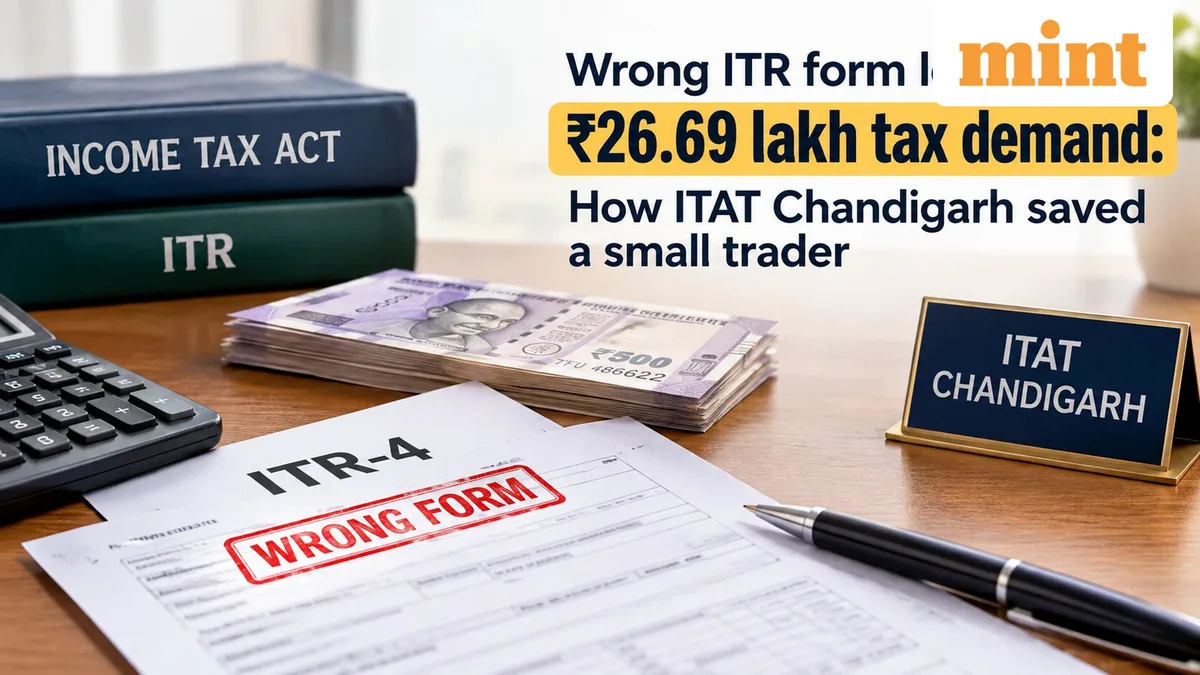
Wrong ITR form led to ₹26.69 lakh tax demand: How ITAT Chandigarh saved a small trader
A lapse of concentration by a small trader while filing his income tax returns resulted in a ₹ 26.69 lakh tax demand. This occurred after the tax department treated the ‘commission receipts’ that were already included in the taxpayer's business income as fresh income.
The Income Tax Appellate Tribunal (ITAT), Chandigarh, has now deleted the entire addition, clearly explaining why it is necessary for taxpayers and tax authorities responsible for checking tax returns to distinguish between a filing error and actual income concealment, as they are entirely different.
This is a case concerning the assessment year 2017-18 and involves commission earned from the sale of mobile recharges and SIM cards, as reported by Moneycontrol. The taxpayer here, while filing their tax return, filed ITR-4 instead of ITR-3 for business income. This resulted in a ‘procedural discrepancy.’
During the processing of the tax return under Section 143(1) of the Income Tax Act, 1961, the Centralised Processing Centre (CPC) relied entirely on Form 26AS, which showed gross commission receipts of ₹ 26,69, 319 as reported by telecom operators after calculating and deducting tax under Section 194H.
The taxpayer , on his part, maintained that these receipts were already included in his clearly declared business income details. That is why adding the entire amount again resulted in the same income being taxed twice, as per him.
Furthermore, the taxpayers' Section 154 rectification application was also rejected. This was followed by the dismissal of his appeal before the Commissioner of Income Tax (Appeals). The CIT (A) emphasised the incorrect ITR form and the absence of a revised return establishing the claim.
While highlighting his grievances and case facts before the Tribunal, the taxpayer produced the corrected return and essential supporting documents demonstrating that the commission receipts were clearly embedded in the income declared originally.
After diligently reviewing the facts of the case, the ITAT held that filing the wrong or incorrect ITR form could not, by itself, establish that the income was undisclosed.
The ITAT further added: This distinguishes this particular case from a fresh deduction or claim restricted by the Supreme Court’s Goetze (India) Ltd. v. CIT ruling. The taxpayer here was only seeking recognition that income had already been offered to tax.
This ruling presents several very important lessons for taxpayers. Lessons that can foster seamless, improved tax compliance in the years to come. The first is that the ruling does not permit taxpayers to use incorrect ITR forms or treat tax returns hurriedly.
It also highlights the significance of carefully checking and reconciling Form 26AS/AIS receipts with the income reported in the return. It is therefore the responsibility of taxpayers to rectify filing errors and omissions wherever possible, preserve supporting documents and records, and also to respond promptly to Section 143 (1) additions.
Finally, the decision is fact-specific and not a blanket exemption for correct filing.
5News aggregated this summary from the outlet’s public feed. The full article, with all the context, is on www.livemint.com — the content belongs to LiveMint - Money.